Showing posts with label Tania Bruguera. Show all posts

Sunday, September 19, 2010

LIVERPOOOL BIENNIAL 2010, CURATED BY LORENZO FUSI


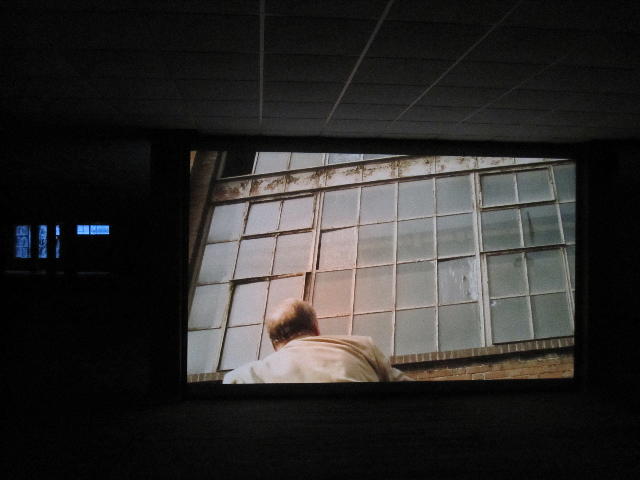
Allan Kaprow, 'Re-Invention of the Office Boy', 1987, reenacted by Tania Bruguera on request of the curator


Tania Bruguera/Catedra Arte de Conducta, space to be filled by the work develped by the artist of Catedra Arte de Conducta during the course of the biennial


Rosa Barba, pipes with the sound coming from the Mersey Tunnels


Lorenzo Fusi, curator of the Liverpool Biennial, standing next to barrels for Alan Kaprow's 'Transfer' (1968), to be reinvented by Kaprow's son Bram and Tania Bruguera


empty spaces at the Old Rapid Hardware Building one of the locations of the Liverpool Biennial. the spacing out of these empty spaces throughout the exhibition, gave it a rhythm and avoided the saturation which prevails in many similar exhibitions


Meshac Gaba's 'Souvenir Palace'


Minerva Cuevas critique of Del Monte's exploitation in Guatemala and Latin America


Julieta Aranda and Anton Vidokle's 'Time Bank'


Karmelo Bermejo's Recession fireworks video


Alfredo Jaar's 'Marx's Lounge'


Alan Kaprow's 'Transfer' (1968), reinvented by Bram Kaprow and Tania Bruguera, interrupting the inaugural speech of Lewis Biggs, Artistic Director of the Liverpool Biennial


Tehching Hsieh, 'One Year Performance 1980-81' in FACT


Carol Rama


Emese Benczur's 'Think About Your Future'


Do Ho Suh's 'Bridging Home'


Cristina Lucas great film 'Touch and Go' which documents retired unionists (of unions that don't exist anymore becomes most industries disapeared from Liverpool) throwing stones at the facade of the building of Europleasure International.

some of the curatorial statements:

*
PUBLIC REALM | Curated by Lorenzo Fusi
Projects in the public realm are spread accross the city in various venues.
Artists:Rosa Barba, Laura Belem, Emese Benczur, Danica Dakic, Song Dong, Alfredo Jaar, Will Kwan, Cristina Lucas, Tala Madani, Kris Martin, NS Harsha, Raymond Pettibon, Do Ho Suh, Ryan Trecartin and Hector Zamora.

The ambivalence implicit in the title of the exhibition (a chiasm insisting on a scheme of mutual reciprocity: who / what has touched whom / what and who / what is touched by whom / what?) provides the field of our investigation. Particularly in the public realm (where the distinctions between the makers and consumers of art are often blurred and their roles interchangeable) it’s very complex to assess who is the active agent and who’s the passive receiver.

The dystopic scenario that has resulted from the fall of ideologies and the deconstruction of faiths and belief, has redefined the relation between reality and art. But most significantly, it questions artists’ (and everyone else’s) authority. The impact and relevance of individual authority in most political and social processes of decision-making seem very limited, although the entire globe is slowly moving towards a diffused democratic sovereignty. What is it then that is still missing?

Even amongst the most radical fringes of political discourse and theoretical / philosophical thinking (i.e. Antonio Negri), the answer seems now to be: love. The reconciliation between art and a multifaceted understanding of love or affection (that doesn’t exclude its opposite, that’s to say hate) represents the core element of this section of the exhibition. A more holistic approach to life, that’s reflected in the enlarging mirror of art. “A painter speaks with his entire body, maintains Valéry. And, in fact, a Spirit that could paint has yet to be seen” (Maurice Merleau-Ponty).

*
Re:Thinking Trade | Curated by Lorenzo Fusi
52 Renshaw Street, L1 4PN
Artists: Minerva Cuevas, Julieta Aranda and Anton Vidokle, Daniel Knorr, Meschac Gaba, Karmelo Bermejo, Freee and Lee Mingwei.

Since the social activism of the 1960s, many artists have taken a critical stance towards both capitalism and the dominant consumerism of ‘advanced’ societies. Bypassing, resisting, or intervening in the mechanisms of late capitalism, they have sought to make ‘socially relevant’ art that works outside or against the constraints of capitalism and consumerism, returning producer and consumer to a more human relationship.

Re:Thinking Trade proposes to touch the city through ‘art re-appropriation’. Disused retail spaces will be revived as temporary venues for art-projects. Newly conceived artworks (and some existing ones not previously presented in the UK) will offer the viewer, or ‘customer’, a wide range of experiences and a variety of alternative ways to trade their time and attention in exchange for a benefit. At times the benefit will be a tangible product. More often it will be a ‘gift’ from the artist, more ethereal and impalpable: an intellectual or emotional device to touch the recipient’s general wellbeing or self-perception.

*
Catedra Arte de Conducta | Curated by Lorenzo Fusi
52 Renshaw Street, L1 4PN
Founded by Cuban artist Tania Bruguera in 2002, Catedra Arte de Conducta was an informal institution dedicated to producing a new generation of Cuban artists. Concentrating on live art, the Catedra used the city and its social realities as its creative material. The school is now closed: its inclusion in ‘Touched’ will represent the last and conclusive chapter in its history.

Art touches a city most effectively when a personal change (in response to an artwork) is collectively experienced. If this change in self-awareness empowers people to take action and responsibility for their lives and their environment, art has touched the city in its complexity. To make something that is at once political and poetic remains very difficult indeed. We hope that in Liverpool the Catedra will provide a range of responses to this challenge, and also show how the notion of embodiment can shift into that of emplacement to introduce art, people and place to each other effectively.

The Catedra Arte de Conducta will investigate two themes: the utopian city / ideal society; and the legacy of American performance artist Allan Kaprow, through the reinterpretation of one of his seminal works. The project will be a blank canvas at the time of the opening, unrolling through the exhibition period. Gradually, different actions by the twenty artists involved will sediment and accumulate, taking the shape of a group show in progress. Polyphonic, inclusive, self-reflective, analytical and critical, experimental, engaging, stimulating, anti-monumental, fluid: these are some of the words to define this idea. The guiding principle is not to provide a preset response, standing there for all to admire, but to show the processes and intimate motivations behind making and thinking.

visit the Liverpool Biennial's complicated to understand website:
http://www.biennial.com

Thursday, June 10, 2010

TANIA BRUGUERA CANCELS PERFORMANCE IN ITALY BECAUSE SHE RECEIVED AN ILLUMINATED MESSAGE FROM DEAD POPE


CONVERSATION. TANIA BRUGUERA’S MESSAGE
Author: Antonello Tolve
Date: 6 -10- 2010
http://www.teknemedia.net/magazine_detail.html?.mId=7964

Antonello Tolve. From provocation to action. From the reflexive accident on the present to the transformation of reality into what is extraordinary Your work frequently intends to dislocate what is commonplace and show some passages of life to provide evidence, with sharp blows, of places and occasions stemming from varied background and nature. Although in this recent work you have organized a discourse with its starting point in the encouragement, incitation and astonishment of the audience to be then able to break – or at least wear out – the links of reality. Would you like to talk about the performance you created for the Madre?

Tania Bruguera: Although your analysis of my work is correct, this time it is not a performance. I knew it would be risky to express what has happened to me in an artistic context, in part because those who are familiar with my work know that I research the negotiations of the space existing between reality and art and that I do not see art as something different from living experience. Another element that I believe did not help was the type of public that attended, because the message was not for them. I thought that making this announcement in Madre would be the chance to have it in the press so the message would reachthe people it should. I do not think I could have called the press specifically for this message, because nobody would have believed what happened to me. That is why I did not tell the director or the curators of Madre who had invited me what I had to say. I believe this was what made the director so angry with me, but this was the only way I had to send the message and fulfill the mission entrusted to me. The message I read at the lecture was this, more or less, because I jotted it down rather hastily in my notebook: Those who just want to satisfy material desires through the accumulation of goods without bearing in mind the suffering of so many and making selfishness… I cannot read very well what I wrote here, something having to do with “nations.” Then the voice said we needed to raise our soul to God through good actions. The last words were the ones I really liked (this I clearly heard): the new Epiphany of beauty is to be found in the ethics of human beings. In a given way I consider unbelievable what happened to me, because I have always been hounded to define and say why I consider the things I do as art when “they do not seem to be so” and now that it is not art they say it looks like art.

A. T. The aesthetic line you used in this new endeavor tends to create a short circuit, I believe, in the media to put distortions and mistakes in evidence.

T. B. The experience I had does not seem real to me either. It was late at night. I was very tired because I had been the entire day assembling my exhibition and I had just offered some workshops in Vigo (I was all the time coming and going from Pontevedra to Vigo). I actually thought I was half asleep or dreaming. It was a rather weird experience, as being “out of my body.” I had the impression that someone was watching me, but when I turned around there was nobody there. I continued to feel… I don’t know… what I call a presence and then began to hear a voice. I don’t actually remember what it initially said, because I was not paying attention. The first things I remember were that the volcano that has paralyzed Europe, the oil accident and the Guatemala volcano were not mere chance, but signals from God. And that they were a message for people who go about without seeing everything surrounding them to stop and give love, to think over what they are doing with their own lives. It also added that people were too focused on money and consider success was that: just money. This is part of the problem we all face right now: the emphasis – and this is my understanding – in money. The voice also spoke of violence. It spoke in terms that I believe are defined as Ethical Capitalism. When at last I arrived in the hotel there were two things that had an impact on me. The first was that I did not know anything about what had happened in Guatemala because I had been traveling for some days and had not followed the news. I was very frightened, but said: “Ok, Tania, you are not crazy. There is no way you could have known this.” The second was when I looked for the words totus tuus. I asked the voice to give me its confirmation, something I could cling to because nobody would believe me and the voice confirmed totus tuus, which I had not understood, but then I found in Google (I had misspelled the words, but Google gave me the correct spelling). I found out it had to do with John Paul II. There was a last thing the voice said would happen: there was going to be another full-scale event in Asia, but I didn’t say it in the press conference. You can imagine the responsibility of saying something like that, but it is a sure thing that all this is a sort of global call, if I understood well.

A.T. The day of the performance, with the Important Notice sent to the entire Madre mailing-list, you thought it would create a large media kermesse. What was the main purpose of that seemingly sudden gesture?

T. B. The purpose was to comply with the mission of spreading the message as widely as possible and that was what I had in my hands at the moment. It was not a sudden gesture. This happened to me at dawn on Wednesday to Thursday. I was tormented all the time, sharing this secret with two friends who gave me some advice, although it was difficult for me to have them believe me. Because of my artistic and existential experience, I am the last person who anyone could imagine something of that sort would happen and I still do not understand why it happened to me. Everyone know my position on these topics and, especially, on the church. After deeply thinking what to do, I said to myself: “There are things I cannot explain and that I could verify. Perhaps I should not play with this.” I decided that doing both things, the performance and the message, would not be right for the message because it would have created too much confusion. There was no possible link between Touched by Discipline, the performance I had prepared with the femminielli for the Madre Museum, and the importance, the urgency of this message. I really did not consider it appropriate. It was confusion enough because of the swiftness with which things took place: the press had said that I was upset with the city or something like that, and it certainly wasn’t so. This was inaccurate information because of the chaos caused by the sudden change in the program practically the very day when my performance was to take place.

A.T. One last question: Reading one of your papers on aesthetics, I have noticed that you frequently work between what is spontaneous and what is programmed, between what is immediate and what is planned, what is natural and what is artificial.

T.B. In this case, some very odd things have happened. A Spanish friend of mine said that the day I had this experience, last Thursday, was that of the Corpus Christi. What can I say? Some things did not seem to be mere chance to me.

Thursday, February 18, 2010

CARLA, CAROLINA, TANIA AND JUDI: PROJECT ROOMS IN ARCO MADRID CURATED BY MARIA INES RODRIGUEZ, AND TWO MALE PROJECTS, NOT CURATED BY HER


Tania Bruguera's reconstruction of the stolen sign at the entrance of Auschwitz: 'Work makes you Free'


Carolina Caycedo's curtains, an hommage to Latin American female artists that have influenced her, built with clothes from female artists of Carolina's generation


Carla Zaccagnini's phrases written using her phonetical alfabet, the phrase reads 'Dividing the land to unite the World', which is found inscribed all over the Panama Canal


Carla Zaccagnini's video of her crossing the Panama Canal in a sail boat


Judi Werthein's 'Cosa' 2009, air from Madrid, in form of an elephant, made in China


Michael Linares homage to Sol Lewit: beer coolers and beers sculpture


and Santiago Sierra's 'NO, global tour'

Thursday, January 28, 2010

'IT IS IT' CURATED BY MARIA INES RODRIGUEZ IN PUERTO RICO


exhibition view, Carlos Garaicoa tables, David Shrigley 'It is It' painting, 2004


exhibition view


Claire Fontaine 'Passe-partout (Paris 10eme), 2006


Jenny Holzer, 1998


Martha Roesler, 'If it's too bad to be true, it could be DISINFORMATION', 1985


Carlos Garaicoa, 'To Transform Political Speech into Acts, Finally', 2005


Liam Gillick, 'An Experimental Factory in the North of Europe', 2004 (wish it was an experimental factory in the Caribbean!)


Lawrence Wiener, 1989


Gabriel Kuri, 'Quick Standards', 2006


Kendell Geers, 'Batons (circle)', 1994


exhibition view


Claire Fontaine, 'Foreigners Everywhere', 2007


Stan Douglas, 'Set for Inconsolable Memories, Vancouver), 2005


Allora & Calzadilla, 'Citizen-Ship', 2005


Stanley Brouwn, '1KM', 1976


Adrian Paci, 'Centro di Permanenza Temporanea', 2007


Jesus 'Bubu' Negron, 'Igualdad' 2004


Tania Bruguera 'Tatlin's Whisper no. 6', 2009


Carolina Caycedo, 'Herstory', 2009


Lutz Bacher, Carolina Caycedo


Lutz Bacher, 'Jokes (Barry Goldwater)', 1987


Exhibition reading room with lamps by Jorge Pardo (another way of being cuban different to Tania Bruguera's!)


David Lamelas, 'The Dictator'. 1978


Christoph Buchel, 'Parade', 2005


On Kawara 'I am Still Alive', 1984


in the Project Room: Carolina Caycedo, 'Swarm', 2009


Carolina Caycedo in front of her work


two cheverista women! curator Maria Ines Rodriguez and Carolina Caycedo


It is it and something else...
curated by Maria Ines Rodriguez

This season, Espacio 1414 presents three exhibitions that propose reflections
on the position of the artist towards the real, a confrontation of what the world
is and what it could be. Both It is It, Swarm and the works selected for the
Painting Room prove the complexity of the contemporary world and the geopolitical,
social and economic implications it entails. The new cartographies of
power that have arisen in the wake of contemporary conflicts, have redefined
new kinds of hierarchies and interests affecting civil society. Whether at a local
or a global level artists generate, through their work, another kind of cultural
construction that questions the universality of notions relating to territory,
totalitarianisms, displacement, belonging or exclusion and, therefore, the limits
of contemporaneity. Based upon the exhibited works, we state that art
continues to be one of the few remaining possibilities we have to create
interstices between terror and escape, room for reflection and discussion that
allows both artists and public to build a critical position towards the context in
which they live.

If, as writer Édouard Glissant pointed out, “the role of artists is to make certain
things visible in the mind and the imaginary so that change can come about”,
we might add that the role of the spectator, in turn, is to assume itself as an
active and emancipated player towards what the artist proposes, so that the
possible change suggested by Glissant can take place.

María Inés Rodríguez.
Curator.

http://www.espacio1414.org/