Showing posts with label Guatemala. Show all posts

Sunday, November 27, 2011

Energies of Place ~ Lake Atitlan


i escaped the clutches of the lake, or that is the way it feels. Felt it dragging me to its depths at times, to that which lay below and within. At times it shown brightly at me, like the day i watched the sun or something sparkle upon it, in lines and geometric designs and across [...]
Read Full Post »

Wednesday, October 19, 2011

Guatemala: Finding peace in the volcano’s shadow

Reposted from Telegraph Travel, UK:


http://www.telegraph.co.uk/travel/destinations/centralamericaandcaribbean/guatemala/8831011/Guatemala-Finding-peace-in-the-volcanos-shadow.html

Guatemala: Finding peace in the volcano’s shadow


Antigua is fascinating, but Lake Atitlán really is too much of a good thing, finds Rhymer Rigby.

Guatemala: Finding peace in the volcano's shadow
Image 1 of 4
Atitlán's famed clarity means the swimming is great. There's also a bit of a hippie vibe 
Antigua is a great place to wake up. We’d arrived in the middle of the night after 20 hours of planes, stopovers and cabs with two small children. But when I stumbled, jet-lagged, onto our balcony it was all worth it. The red-tiled roofs of a beautifully preserved Spanish colonial city, punctuated by flowering trees and church bell-towers, stretched to the base of a giant conical volcano. And it was warm and sunny, but pleasantly so, as Antigua’s altitude cools the steam-bath heat of the tropics.
This Guatemalan town is cute and knows it, but it’s none the worse for this. Paradoxically, the city owes its remarkable state of preservation to the destructive power of the spectacular volcanoes around it. The Spanish built it as their third Central American capital in 1543, when it went by the name of La muy Noble y muy Leal Ciudad de Santiago de los Caballeros de Goathemala. For centuries it was Central America’s most powerful city, something to which the grand civic buildings and elegant private houses bear witness.
But the area was very geologically active and, after a particularly destructive earthquake in 1773, Antigua was evacuated and the capital moved to Guatemala City. Antigua was never really abandoned but its relegation meant that, the odd earthquake notwithstanding, it retained its 18th-century charm while Guatemala City became an unlovely and unsafe urban sprawl.
Antigua’s geological instability has also resulted in an extraordinary vernacular architecture. Buildings, although recognisably Spanish in design, are low and massive. Single-storey walls are 3ft thick and columns barely 10ft high have the same diameter as those holding up the portico at the British Museum.
The town’s numerous churches are often better appreciated from outside; they’ve been shaken to pieces by earthquakes so many times they tend to be rather plain within. But, many of the humbler buildings such as restaurants and hotels have beautiful, shady courtyards in which to escape the mid-day sun. Antigua is in some ways a bit like Bath or Cambridge – the fabric of the city is the attraction and it’s best seen by walking around.
Neverthless, by day three, we felt we needed to stretch our legs a little more so we booked a day trip to the nearby Pacaya volcano. In years past, you could walk right up to streams of red-hot lava, but the 2010 eruption changed that. Although we couldn’t actually see molten rock, it was gratifyingly volcanic.

We watched smoke belch and rumble out of a crater that looked like an entrance to the underworld, walked across a blackened landscape where the ground was warm to the touch and sweated in a cave dubbed “the natural sauna”.

After four days in Antigua, we headed up to Lake Atitlán, Guatemala’s geological show- stopper. We passed some pretty scenery on the way, but nothing prepares you for the lake. As a scenic set-piece, it is astonishing. When he visited the area in 1933, Aldous Huxley wrote: “Lake Como, it seems to me, touches on the limit of permissibly picturesque, but Atitlán is Como with additional embellishments of several immense volcanoes. It really is too much of a good thing.” He wasn’t exaggerating.

To appreciate the lake you need to get out of its biggest town, Panajachel. We picked up a water taxi at the docks and headed to Santa Cruz, which is everything a lakeside hamlet should be. Here, stretched along a couple of miles of shoreline, are perhaps a dozen hotels, all small and charming, with manicured gardens running down to the lake.

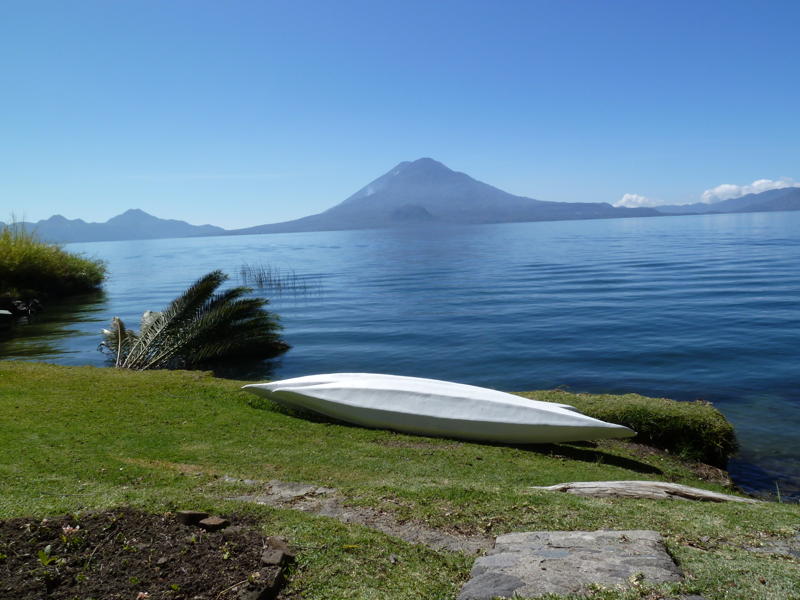
Atitlán’s famed clarity means the swimming is great. There’s also a bit of a hippie vibe. Quite a few foreigners discovered Atitlán in the Sixties and Seventies and our hotel was also a yoga retreat.

Our lakeside routine involved a fruity breakfast, a little swimming and perhaps a walk along the wooded shoreline. If we found this too taxing, we’d soak in the hot tub; in volcanic Guatemala, these are something of a national obsession.

The scenery is stunning and occasionally surprising. Walking along the lake at sunset one day, I could see what looked like a bush fire. But a local man told me, no, it was volcanic steam or smoke venting. Hardly surprising: although the last major eruption was in the 19th century, the area remains active and the lake is not only watched over by three volcanoes, the basin itself is a volcanic caldera.

We’d only intended to spend three days at Atitlán, but found it so relaxing, we extended to nearly a week. You probably could spend seven days doing nothing other than looking at the views but there are plenty of other activities. We hiked in the mountains around the lake and hailed water taxis to visit the little villages that dot the shores.

I climbed Volcán San Pedro, walking up through coffee plantations and cloud-forest to enjoy a bird’s-eye view of the lake.

Had we stayed longer we could even have scuba dived and parasailed. But eventually, my wife told me that we really had to leave.

As I carried our luggage to the jetty, I suggested that we might extend our stay. But she was adamant. It was time to go – and I daresay she was right.

Lake Atitlán is already too much of a good thing. And you don’t want to have too much of a good thing.

GETTING THERE
American Airlines (0844 499 7300; americanairlines.co.uk) flies to Guatemala City via Miami from around £600 return. Most hotels in Antigua offer an airport pick-up, which takes 45 minutes and costs about £40.
PACKAGES
Journey Latin America
(020 8747 8315; journeylatinamerica.co.uk) offers a 13-night package to Guatemala, from £1,581 per person, excluding return flight. Exodus (0845 287 7543; exodus.co.uk) has two 16-night packages to Guatemala, from £2,079 per person, including return flight.
THE BEST HOTELS
Casa del Parque, Antigua ££
A minute’s walk from the beautiful central square, in a traditional building, Casa del Parque is a friendly, good-value hotel with a swimming pool and hot tub.
Ask for a room on the upper floor as the few extra dollars are worth it for the views (00502 7832 0961; hotelcasadelparque.com ; doubles from US$80/£50 per night).
Villa Sumaya, Lake Atitlán ££
Set in gorgeous lan dscaped grounds on the shores of Lake Atitlán, Villa Sumaya is a great place to stay whether you’re into yoga or not. It has a swimming pool, hot tub, sauna and offers a range of spa treatments. The food is fantastic, much of it home grown (4026 1390; villasumaya.com; from US$80/£50).
Posada del Angel, Antigua £££
The place where Bill Clinton stayed when he visited in 1999, Posada del Angel is small, exclusive and immaculately decorated in a style that retains much of the building’s original charm. It’s expensive by Guatemalan standards, but still great value (7832 0260; posadadelangel.com; from US$210/£131).
THE BEST RESTAURANTS
La Esquina, Antigua £
If you want to eat authentic Guatemalan food, but with a slightly haute cuisine twist, this is the place to do it
(6a Calle Poniente No 7-5a Avenue Sur; 7882 4761).
Sunset Café, Panajachel £
It’s a fair bet you will need to eat in Panajachel at some point as it has the greatest concentration of facilities on Lake Atitlán and is the gateway to the lake. The Sunset Café has a superb location and, as its name suggests, has some of the best views of Atitlán’s extraordinary sunsets (corner of Calle Santander and Calle del Lago; 7762 0003).
Casa Escobar, Antigua ££
If you tire of basic but typical Guatemalan dishes and feel in need of a more upmarket experience, Casa Escobar does an excellent steak, along with a good, largely South American wine list. The restaurant has a sophisticated feel, too (6a Avienda Norte No 3; 7832 5250).

What to avoid

Most visitors skip Guatemala City entirely – and with good reason, as it has high levels of crime and poverty and rather lower levels of attractions.
Panajachel, on Lake Atitlán, is not a great place to stay either, but that’s because it’s scruffy, rather than dangerous. You want to be out on the lake.
Public water taxis run on the lake from 7am and are used by visitors and locals alike. If someone tells you that they’re not available it’s almost certainly because they’re trying to sell you a pricier private boat. Although they have designated stops, the public boats will dock at any jetty they pass on request.
1 comments

Showing 1 comment

Real-time updating is enabled. (Pause)
Antigua is totally gorgeous, but extremely touristy (think groups of Americans down for a week or so to 'do' Central America) For the real Guatemalan experience, head to Quetzaltenango in the Western Highlands, Guatemala's second biggest city but with none of the issues of the capital. Within near reach of some beautiful volcano hikes and only 2 hours from lake Atitlan it is also one of the cheapest places in the world to study Spanish, with one-on-one classes and lots of after class activities.  And unlike Antigua,  also has a ton of Spanish schools, people in Xela (as Quetzaltenango is know locally) will actually speak to you in Spanish, not English! I loved it and can't wait to get back to Guatemala.
Here is where I studied, Utatlan Spanish School: www.spanishxela.com

Friday, February 11, 2011

FotoKids.org


fotokids.org


© All photos copyright Fotokids 2007

---
http://www.fotokids.org/newsletter_current.htm

FOTOKIDS
Fundación de Niños Artistas de Guatemala

December 2010
Letter from the Exec. Director

The rains have stopped. There is a nip in the crisp mountain air and the bougainvillea has burst into bloom. The winter winds pick up and bring the smell of wood smoke. Although 46 degrees isn’t considered cold by most of you, there is no heating here and so at 6 a.m. I’m writing tucked under the covers with Jack the dog curled up next to me and a strong cup of Guatemalan coffee. The volcano Fuego is erupting sending fists of smoke into the blue, blue sky.

Soon it will be Christmas season with pine needles spread on the floor, that will offer up their aroma as you walk over them, tamales, hot fruit punch, processions and the sound of singing as the posadas go from house to house asking to be let in (and given hot chocolate).

The season will be ushered in by Handel’s Messiah in the ruins of an old convent lit by hundreds of votive candles.

You know it’s been a rough year for us but we have forged ahead and have, despite challenges gotten a lot accomplished, and I’m happy. October/ November are grant writing months for me and so I get to take a long lingering look back. This year we have expanded the program and brought in 60 more students ages 5 to 14 in three difficult, dangerous barrios.

Abdias and Werner (18 years old now) both have found they really enjoy teaching and get a kick out of the little kids calling them profie (for professor) and confiding their secrets. There is so much good bonding that

Happy Holidays!!!! goes on as the older Fotokids teach in their own neighborhoods and set an example of what you can do if you stay in school and stay in the program.

The 3-year Save Girls program graduates 10 young women this year (can’t believe its been three years already, but then hey, neither can I get my head around the fact that Fotokids will celebrate it’s 20th anniversary next year) and we are taking on Ana, Gaby and Jessica from the program as interns. They will help us teach a public school class of fourth graders, conduct workshops in our new anti-violence program and work in the design studio Jakaramba. As a side note we are looking for sponsors to fund their university scholarships. Ana has been accepted into the school of architecture and Gaby and Jessica in graphic design at San Carlos University.

Save Girls has been so successful in terms of student participation and motivation that we duplicated it this year with Marta teaching in Tierra Nueva 1 and have plans to expand it again in 2011.

We continue to bring in international professionals to teach students and have been blessed with many good mentors who have given workshops in book design, HDR (high dynamic range) photography, Adobe Lightroom, studio lighting, advanced Photoshop, portraiture and business planning.

I went with Evelyn and Nancy Morales up to California, where former Admin. Director Logan had arranged for us to present the Fotokids model at the California state teachers conference. First time for Evie and Nancy to give an extemporaneous workshop in English. They did quite well and best of all we met a group there that works in video in SF with at-risk kids that we would like to bring down here to teach. In 2011, as I have mentioned in previous newsletters, we are looking at meeting the violence in the neighborhoods head on.

Well as head-on as we can get without losing ours. The extortion by gangs has gotten so bad that I overhear things like, “there are only 2 houses occupied on my block of 12 homes. Everyone else has moved out, they can’t pay the protection money.”

I’ll give you more details on that program in the next newsletter, but it’s kind of exciting and it may at least get people thinking that something can be done, you know if you can’t see there might be a solution, you’ll never find one.

If you want a copy of the 2010 annual report send me an e-mail info@fotokids and I’ll send it along.

Thanks to you all we were able to replace, and I might add upgrade, our computers and cameras! So things are going well. We have our Fotokids graduates, most of them with at least 12 years experience in the project, giving back to their communities and I consider them national treasures. We have many things to be thankful for this year.

What’s New with the Kids

Rosa’s 9-12 year old class are working on advertising copy and using design software to make labels for imaginary products. The slogans (and products) were interesting: Royal Chocolate Cereal, helps make you fatter! Kill Lice Shampoo smells like fruit and is white, Fiesta juice made with lemon, orange and a touch of alcohol, “Life is fresher with Fiesta!”, Vegetable Shampoo, 100% natural ingredients, squash, carrot, tomato and broccoli, Sugar the Original! with orange flavoring, you don’t need kool-aid just add water!

David Ixbalán, after a successful and busy internship with a local cable television studio designing their logo and inauguration campaign, has graduated from design high school! His family came down from Santiago Atitlan and were so proud of his accomplishments. His Dad rents a cornfield to eke out their meager income and his mom sells tomatoes in 3 markets to help the family with oil, soap and the necessities. David has been with us since he was 9 years old and is a talented designer. We are considering setting up a space in central Santiago Atitlán for the Lake version of Jakaramba, where David and Josefa can develop the design studio there. It’s important that the indigenous kids from there have a chance to use the skill they have developed to serve and be reintegrated into their own communities

.
David with his Mother and Dad photo by Linda Morales

Holy, also from Santiago Atitlán who her father told us last January would not be studying, had obviously changed her mind and graduated from high school this year in pre-med.

Andres and Nancy have photos published in Revista the magazine published by the David Rockefeller Center for Latin American Studies at Harvard along side an article excerpted from our very own Fotokids June newsletter (written by your humble correspondent). http://www.drclas.harvard.edu/publications/revistaonline/fall-2010-winter-2011/cyclones-violence

Linda documented a film being made on the Peten by Ana Carlos, a Guatemalan television producer, and also worked for the Paiz Foundation documenting their marimba festival.
Janne works for the newspaper photo by Werner Monterroso

Eleven year old Janne and 13 year old Nestor from Werner and Abdias’s class in Mezquital did a photo assignment for the Guatemalan newspaper Siglo 21 taking pictures of for a supplement on the day of the child.

Those of you who remember Gladiz, one of the original Fotokids from near the dump, will be interested to know I went to her wedding! She’s 29 now, working as a medical receptionist and made a good match I’d say with a rather jolly lawyer who seems very kind. They are every much in love and expecting their first child.

Yamilet brought in her new baby to show us. I don’t know what will happen there, I know Yami is planning on going back to school but with a new baby who knows.
Evelyn, Administrative Director of Fotokids and Nancy of design studio Jakaramba attended staff management workshops in California. I went too and they were good workshops, gave me things to think about. We stayed at my Dad’s place in San Francisco and that’s always fun to show people around, China Town, the Park, taking the ferry etc.

We had a younger kids exhibit as part of Foto30, Guatemala’s month of Photography and we bussed in the kids from Tierra Nueva and Mezquital. Our kids all wore their black Fotokids tee shirts and brought their cameras. It was a little like being surrounded by tiny paparazzi, every time I looked up, or didn’t, or was talking to someone there was a flash going off. People were impressed by the kids work, especially, and no surprise, the ones that depicted violence. Many others though were noted as well. We had a big turn out in terms of audience.

We are working with Colegio Maya, an excellent private school in Guatemala City, and they have taken us on as their outreach project this year. We are doing a small gallery presentation as part of a fundraiser in conjunction with their production of a Mid Summers’ Night Dream. We are photographing dreams.

Alex, Jorge, Kevin and Steven spent the Day of the Dead with me in Antigua. So many things have happened that this year, that although we did cover the families celebrating and flowering the grave-sites in the cemetery, I added some additional activities. We visited a thoroughly enjoyable installation at the Cooperative Española on the synchronization of music in the Americas with sound, video and dance steps painted onto the floor. Steven and Kevin tried the tango and Alex the rumba. Then we went swimming in a friend’s pool just to blow off all the heavy things that have happened recently.

You may have noticed that this newsletter is a bit more upbeat - that’s because the Holiday season is coming and I don’t want to depress you. If you are interested in hearing everything that’s going on, not for the faint of heart, you can subscribe to the private Dump Insider’s Edition blog, at info@fotokids.org
We are also on FaceBook in two locations, Fotokids and Fotokids Santiago.

Honduras- GUARUMA students and first time travelers Adolfo and David were invited to Missouri gave talks and presentations to Runge Centre and River Bluffs Audubon Assocation- http://www.guaruma.org/blog/
Order the 2011 Guaruma Calendar on Sale Nov. 26th $12.50 (inclds shipping) U.S.A. on our web site www.fotokids.org with PayPal or info@guaruma.org

Don’t forget there is a Design4Kids workshops coming up in Las Mangas January 16-22nd. If you want to use your skills in photography, Photoshop design and love nature this is for you. It is so beautiful (see GUARUMA web site to check out what it looks like) and opportunities for nature photography are endless. Birders from the Smithsonian and white water rafters from all over the world have come here. It’s a special place, and so far, unknown to many. The kids will work for a client and there will be ample time to both mentor and take your own photographs. www.design4kids.org


How You Can Help

We will need many more educational scholarships! There are two kinds of scholarships Educational which pays for a students traditional education $300 a year, paid in any way you choose, monthly, quarterly annually, and Fotokids Photography scholarship $150 which pays for our teaching and materials expenses. All our programs are free to the participants.

You can use PayPal button on the opening page of our web site…www.fotokids.org or

Make checks out to: San Carlos Fdn/Fotokids
and send to: Fotokids. P.O. Box 661447, Miami, FL 332


In Memoriam

This Quarterly Newsletter is dedicated to 16 year old Mynor Chavez, a stellar, much loved member of Fotokids for the last 6 years, who was brutally assassinated this month in a neighborhood gang murder.

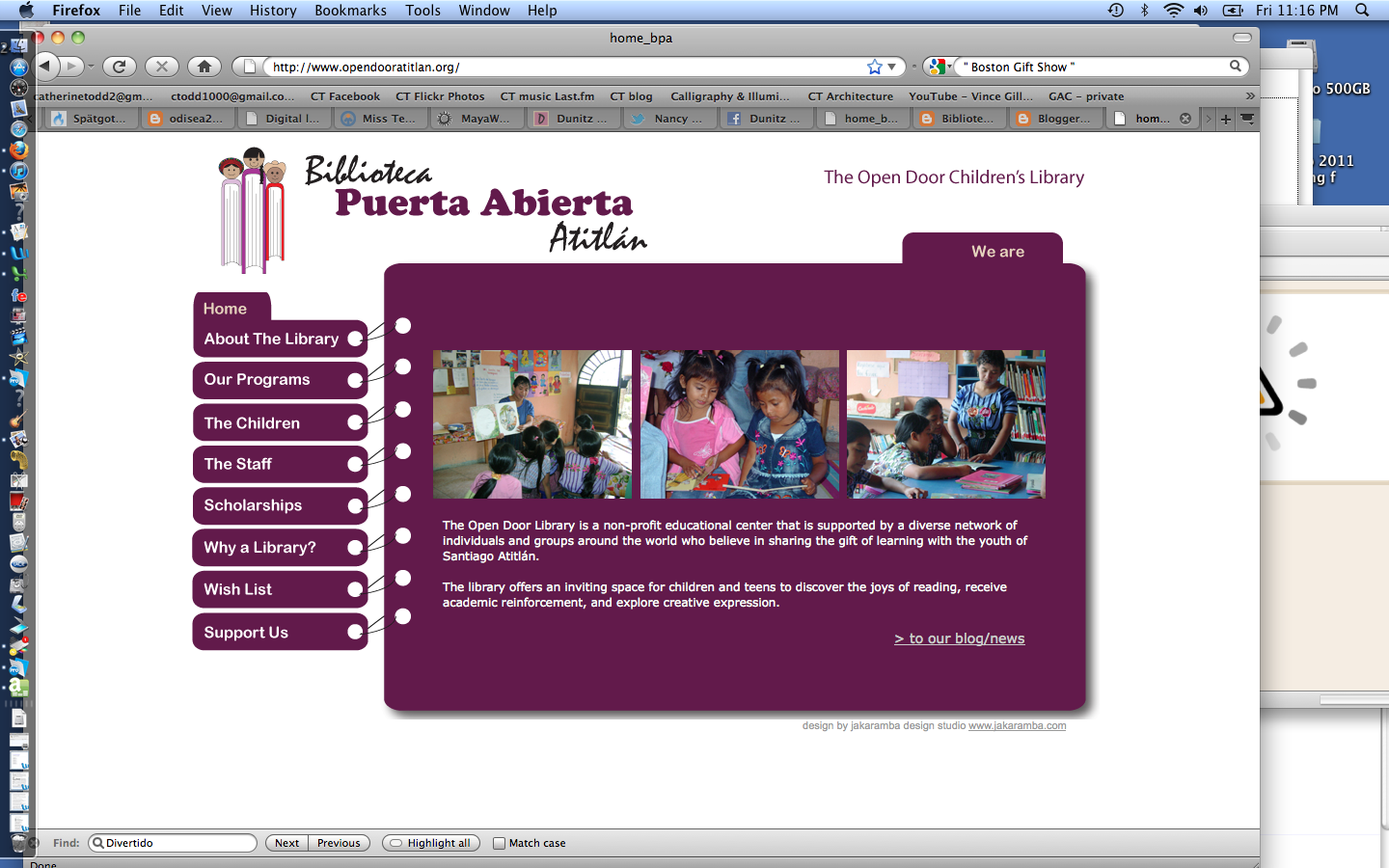
Open Door Atitlan ~ Free Library, Santiago Guatemala

www.opendooratitlan.org

The Open Door Library is a non-profit educational center that is supported by a diverse network of individuals and groups around the world who believe in sharing the gift of learning with the youth of Santiago Atitlán.

The library offers an inviting space for children and teens to discover the joys of reading, receive academic reinforcement, and explore creative expression.

design by jakaramba design studio www.jakaramba.com

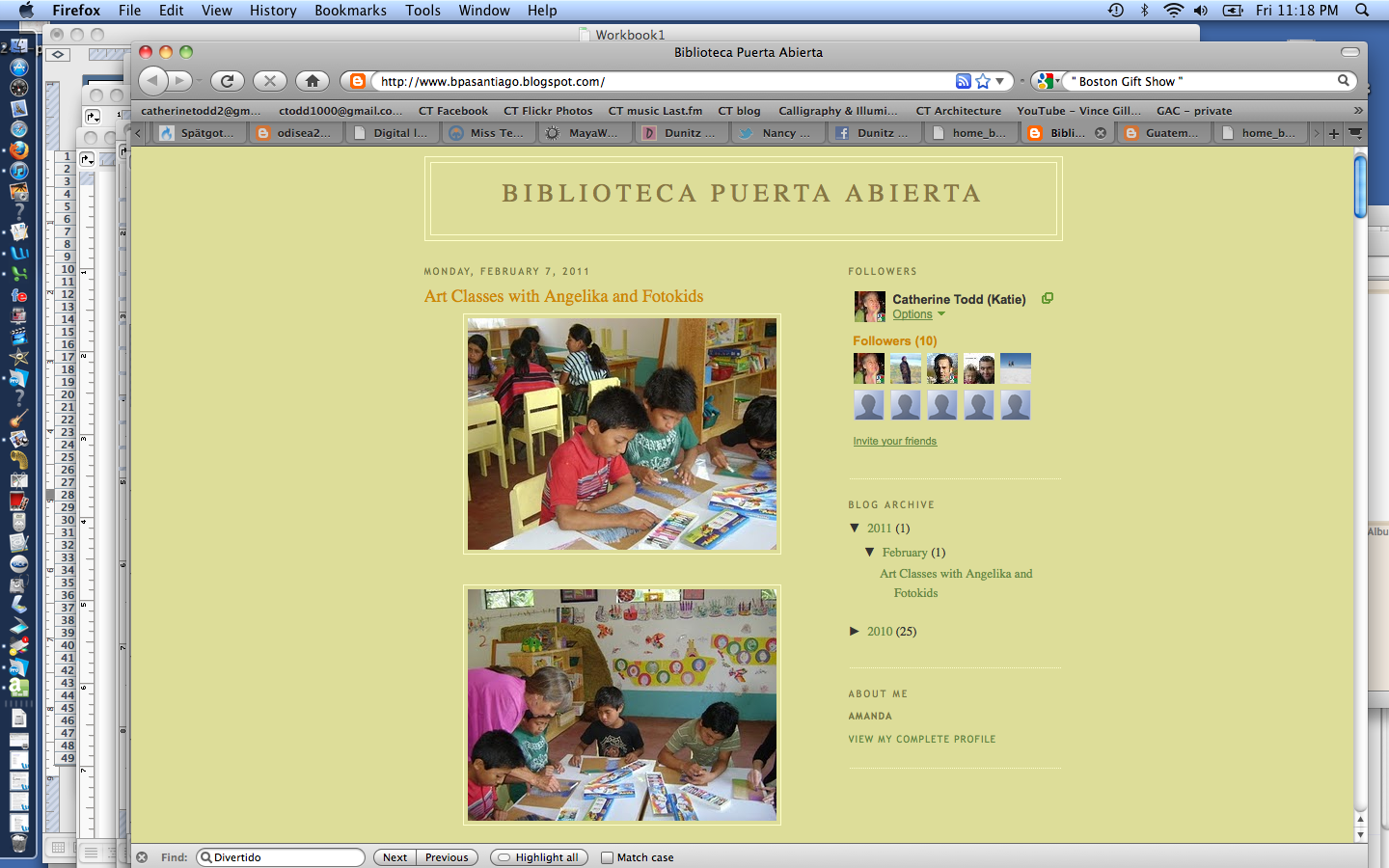
our blog:

http://www.bpasantiago.blogspot.com/

Saturday, February 5, 2011

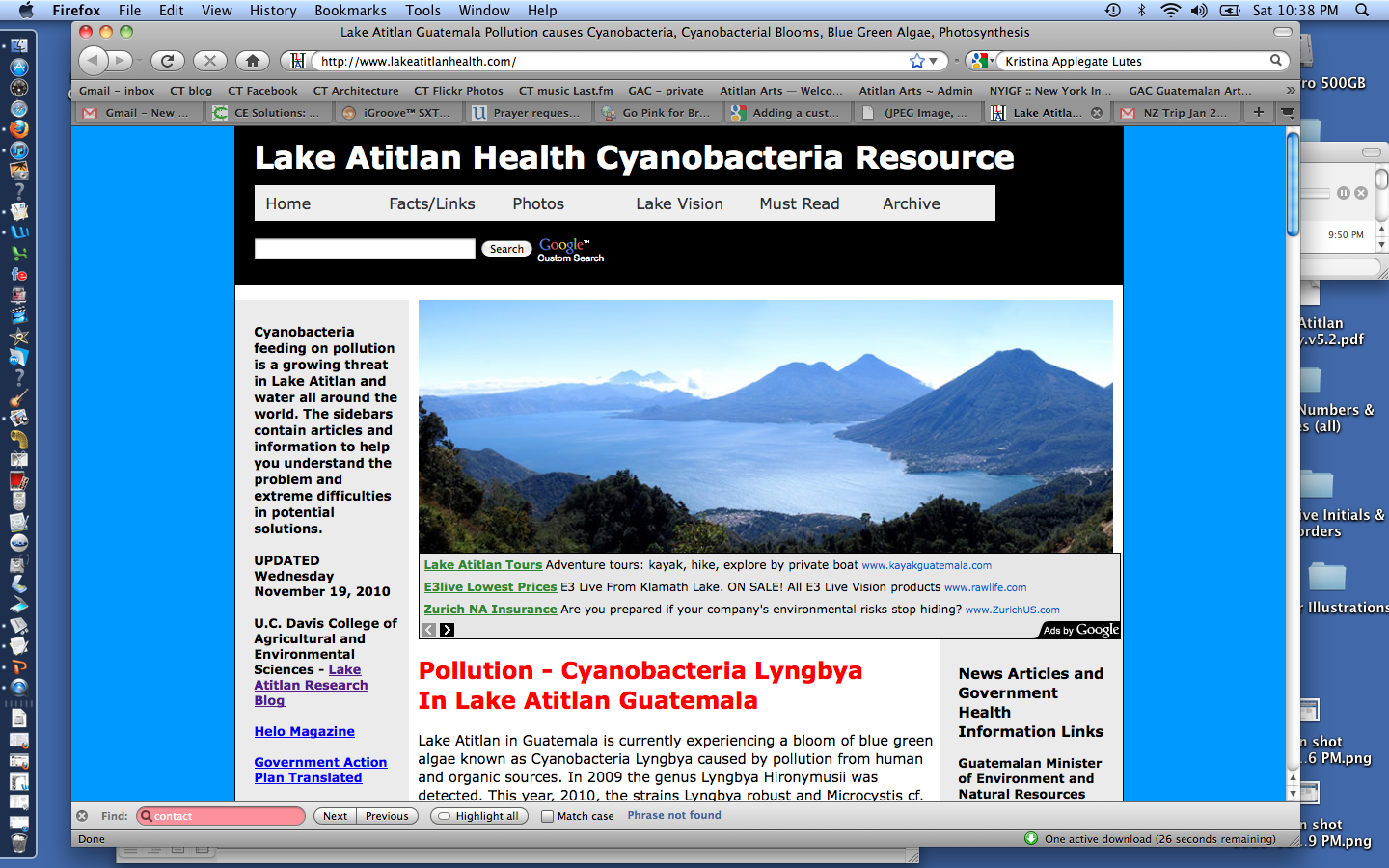
Lake Atitlan Health Cyanobacteria Resource

2.5.11: Anyone heard of any updates from here? This is an udated entry, but it appears to have been posted in Fall 2010. CT


Pollution - Cyanobacteria Lyngbya
In Lake Atitlan Guatemala

Lake Atitlan in Guatemala is currently experiencing a bloom of blue green algae known as Cyanobacteria Lyngbya caused by pollution from human and organic sources. In 2009 the genus Lyngbya Hironymusii was detected. This year, 2010, the strains Lyngbya robust and Microcystis cf. botrys were detected. The bloom this year is not as severe as last year, and November winds are helping to dissipate it.

Located in the highlands of Guatemala, Lake Atitlan is a scenic wonder and a popular tourist destination in the country of Guatemala. There is a large indigenous population around the lake including Tz'utujil and Kakquichel Maya. Many are subsistence farmers who depend on the lake for all of their drinking water and irrigation. Many others rely on the tourist industry.

Roads To Lake Atitlan are Open

There have been reports that the road into Lake Atitlan is closed. This is only true for the main road in from Solola to Panajachel. That road is closed until January for some needed work. There is an alternate route into Panajachel from Antigua, which is well known by the shuttle drivers. As always, it's safest to travel in daylight only due to changeable conditions.

Regular shuttles are also running from Antigua into San Pedro La Laguna on the othe side of Lake Atitlan. The road into San Pedro is open, but a bit rough in places. The shuttle drivers know it well. If you are driving yourself, then use extreme caution as the road is steep and full of switchbacks.

The lake received a record amount of rain this year which has resulted in many landslides and introduced a large quantity of pollution and new nutrients for the Cyanobacteria to feed on. The level of Lake Atitlan has risen over 3 meters, causing flooding of homes and businesses along the lake shore. The loss in tourist revenue associated with these problems has been very difficult for the many people who depend on it for survival.

Cyanobacteria is a form of blue-green algae naturally occurring in waterways and oceans worldwide. It feeds on pollution from agricultural runoff and human waste. It receives nutrients from the pollution in the form of nitrogen and phosphates in the water. The genus Lyngbya, in Atitlan, contains green pigment chlorophyll which traps the energy of sunlight and enables it to carry on photosynthesis. Most cyanobacteria in small concentrations is generally harmless. When cyanobacteria concentrations increase they can form HAB's or hazardous algal blooms. The toxins produced from a "HAB" can include cyanotoxins that induce everything from mild skin rashes to death of animals in cases of extreme exposure. The toxins from Lyngbya can vary widely over short times and could potentially be highly toxic to dogs who come in contact with the lake.

Another recent development is the appearance of Water Hyacinth in some of the bays of Lake Atitlan. This aquatic plant is highly invasive and can choke waterways quickly.

As of July of this year Health Minister Ludwig Ovalle, and the Deputy Minister of Environment for Guatemala, Enma Diaz held a press conference to report evidence of toxicity of cyanobacteria in humans and asked people around Lake Atitlan to refrain from using the lake water for human consumption, irrigation of crops and to not eat the fish, to avoid possible liver complications. "There is evidence that a low percentage of cyanobacteria has produced a toxin that causes liver damage, diarrhea, skin problems and hepatic encephalopathy, among other diseases," explained Ovalle. There were many cases of severe dermatitis reported around the lake from people who came in direct contact with the cyanobacteria during attempts to "clean" the lake in 2009. This was during the peak bloom, where it had amassed in large quantities.

Both Margaret Dix, a scientist at the Universidad del Valle de Guatemala, and Eliska Rejmankova, a scientist at University of California Davis, agree that the cyanobacteria Lyngbya will return annually for the foreseeable future due to the nutrient load in Lake Atitlan. The current cyanobacterial bloom season starts in early September and lasts through late November. Last year the bloom peaked and covered a large portion of the lake in mid October. Seasonal winds helped break up and dissipate much of the bloom in November.

First International Symposium on Cyanobacteria and Cyanotoxins
September 27-29, 2010 in Guatemala

This symposium held at the end of September has not released any detailed recommendations so far. The Minister of the Environment did release a declaration at the end of the symposium which is reprinted below. One of the clear challenges in monitoring cyanobacteria and cyanotoxins is the lack of laboratories capable of analyzing cyanotoxins rapidly enough to disseminate health warnings to the general public, as is demonstrated by the first declaration of the Symposium on Cyanobacteria and Cyanotoxins.
The symposium was the collaboration of the Agency for International Development USAID United States, the Pan American Health Organization, the Mexican Institute of Water Technology (IMTA), the United Nations Educational, Scientific and Cultural Organization (UNESCO), among others.

(more) http://www.lakeatitlanhealth.com/

Partners of the Americas & Kids Share Workshops at ASOCAMPO, Lake Atitlan, Guatemala


Partners of the Americas & Kids Share Workshops at ASOCAMPO, Lake Atitlan, Guatemala

KidsShareWorkshops | November 30, 2010 | 2 likes, 0 dislikes

Dear friends,

I am pleased to share this video with you of our recent visit to Guatemala on a site investigation. It was a very good choice to go first before teaching which I had wanted to do originally. I personally gained a lot of knowledge and additional appreciation for families living in coffee communities. I also feel strongly about working to help these kids with education because they are the future of the coffee plantations from which we enjoy.

After my visit it became clear to me the best way to make a difference is to assist in building an interactive library, arts education, health and sports programs with the help of Partners of the Americas and other non profit organizations. One of our directors also suggested having the Peace Corps involved the first two years so we could have an ongoing presence. These kids have little exposure to the outside world and I am certain few books from which to learn. We did notice a new school was being built. As far as we know only one organization, Catholic Relief Services, which is supported by Green Mountain Coffee Roasters has an active presence. This community was hit hard not too long ago and lost more than half of its family members. But they are rebuilding and feel proud of their heritage and way of life as you will see in the video.

My hope is that by focusing on this rural community for which my employer GMCR purchases coffee from, other NGO's will take notice and want to give to this coffee community as well. Maybe some of you drink coffee, I do. The US is the largest consumer of coffee so I feel it is important to give back to these kids and their families. They are our future and coffee is always going to be important to many folks as it has for many centuries when it originated out of Ethiopia in the 9th century.

Thank you, Kristina Applegate Lutes; Executive Program Director & Founder
Category:

Education

http://www.youtube.com/watch?v=FuKpU5xUC4o&feature=player_embedded

Friday, February 4, 2011

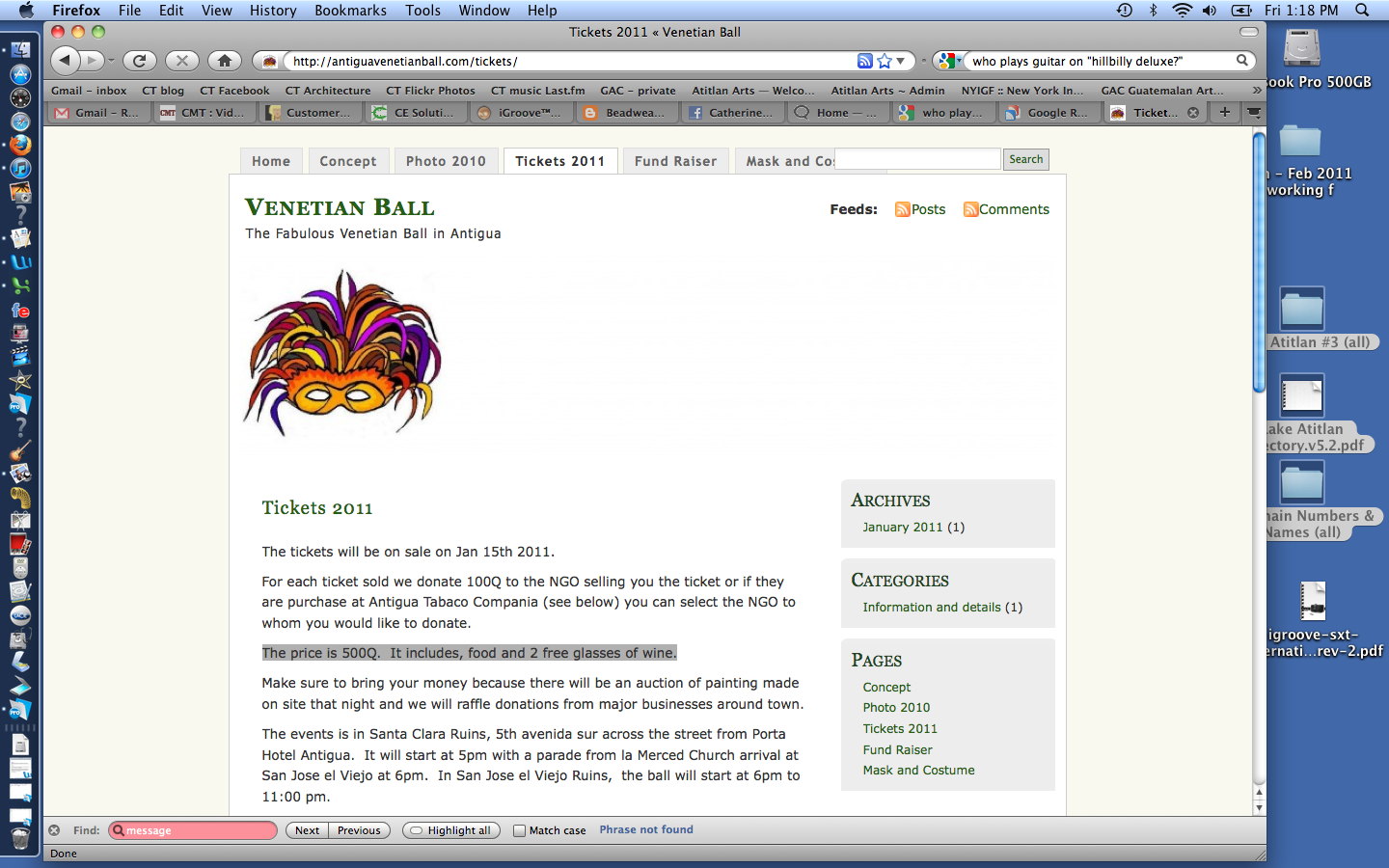
The Fabulous Venetian Ball in Antigua


Revue Magazine: RevueMag.com


March 8

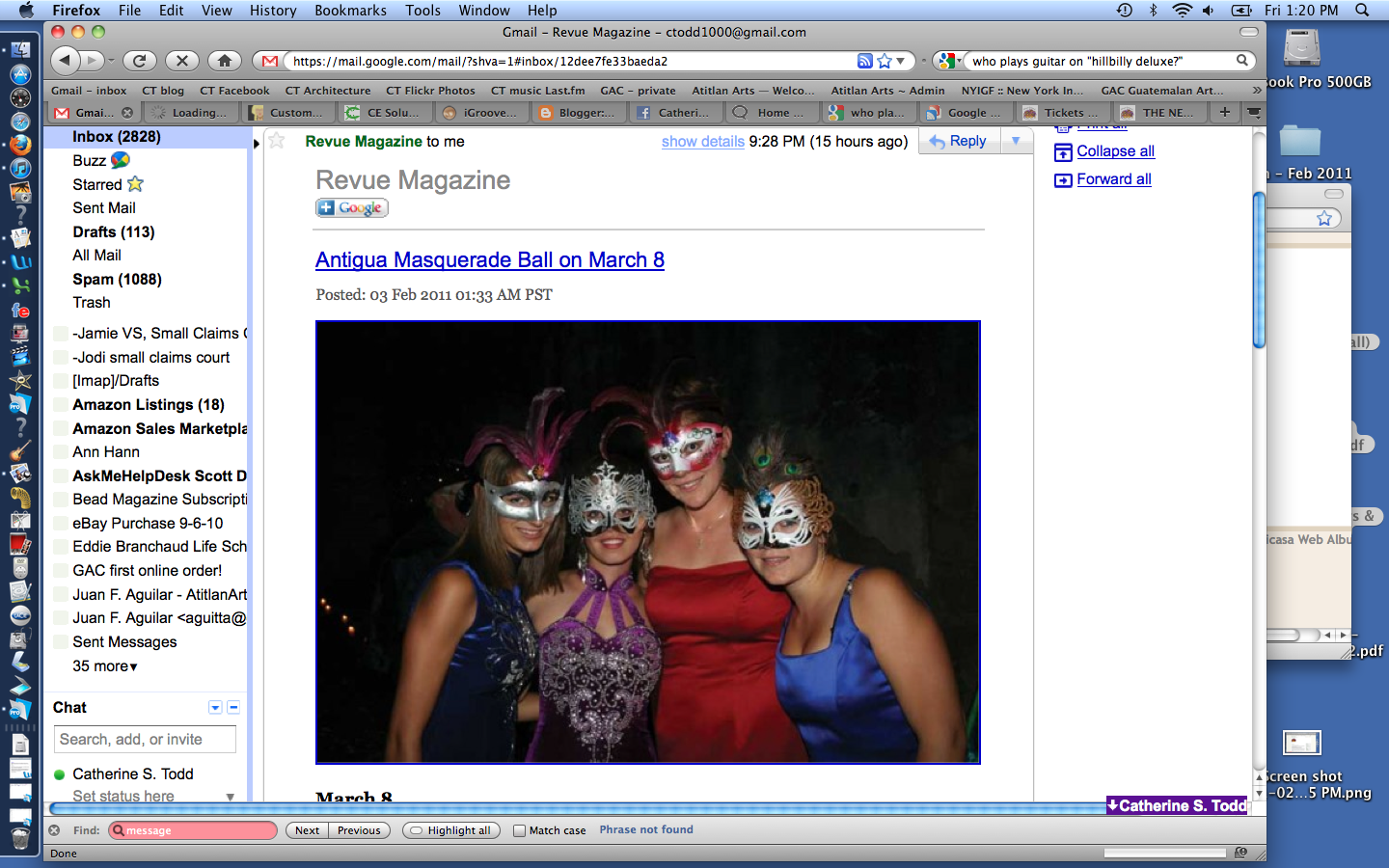
The second annual Antigua Masquerade Ball, a colorful, Venetian-style charity event, is coming to the ruins of San José El Viejo on Fat Tuesday, March 8.

In addition to costume contests, the ball will feature dining, cocktails, music and raffles. There will also be an auction of four unique pieces of art, which the artists will “speed paint” in only 90 minutes.

Event proceeds will support an array of children’s charities, according to event organizer Lyne Bissonnette.

Doors will open at 6 p.m., although participants are invited to gather at La Merced church at 5 p.m. to parade down Fifth Avenue to the venue.

Only 150 tickets (Q500 each) will be sold. The price includes two drinks, food, entertainment and setup. Music and dancing continue until 11 p.m.

Participating NGOs are selling tickets;
for more details visit www.antiguavenetianball.com

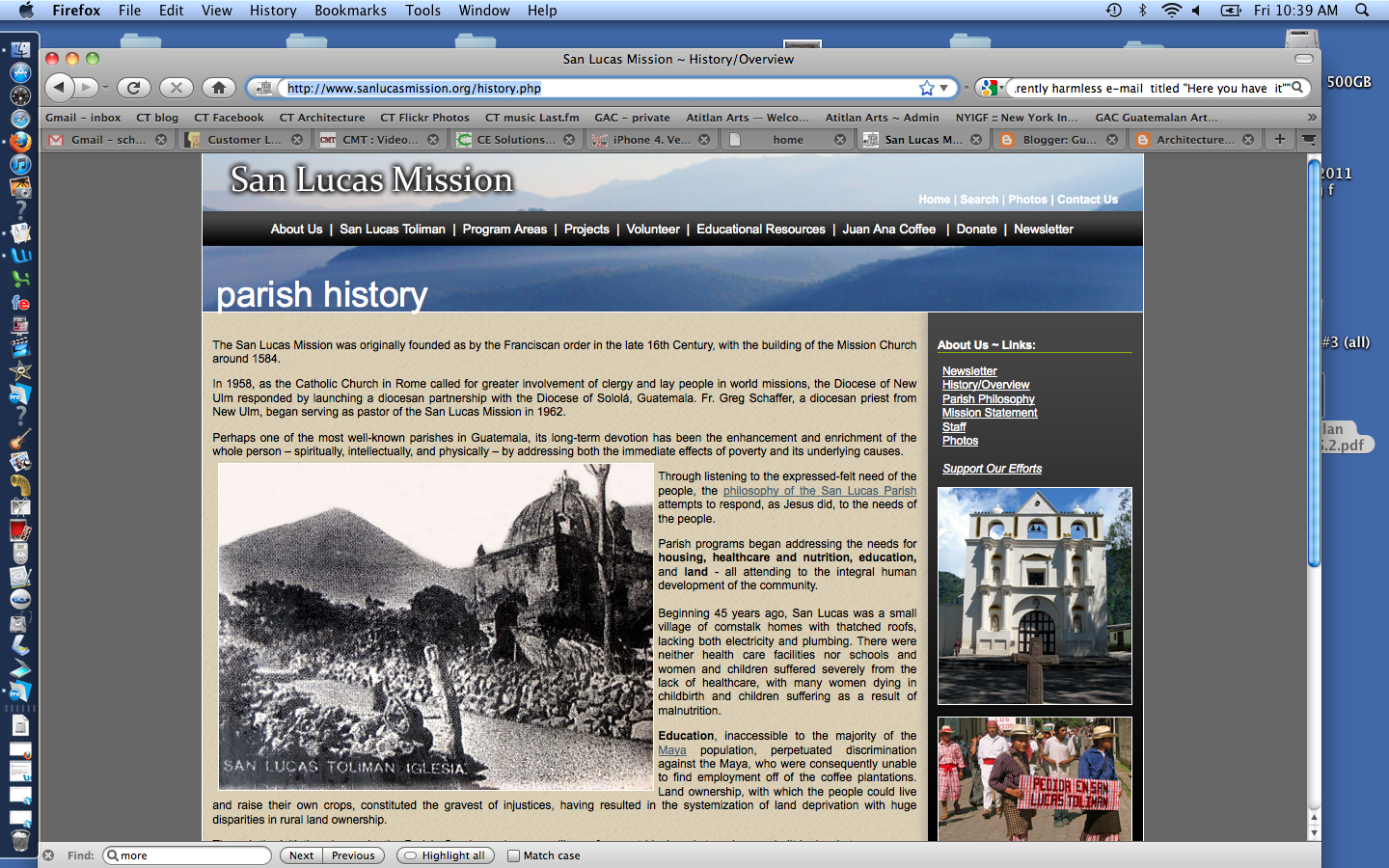
San Lucas Toliman & the San Lucas Mission


http://www.sanlucasmission.org/history.php

About Us | San Lucas Toliman | Program Areas | Projects | Volunteer | Educational Resources | Juan Ana Coffee | Donate | Newsletter
parish history


The San Lucas Mission was originally founded as by the Franciscan order in the late 16th Century, with the building of the Mission Church around 1584.

In 1958, as the Catholic Church in Rome called for greater involvement of clergy and lay people in world missions, the Diocese of New Ulm responded by launching a diocesan partnership with the Diocese of Sololá, Guatemala. Fr. Greg Schaffer, a diocesan priest from New Ulm, began serving as pastor of the San Lucas Mission in 1962.

Perhaps one of the most well-known parishes in Guatemala, its long-term devotion has been the enhancement and enrichment of the whole person – spiritually, intellectually, and physically – by addressing both the immediate effects of poverty and its underlying causes.

Through listening to the expressed-felt need of the people, the philosophy of the San Lucas Parish attempts to respond, as Jesus did, to the needs of the people.

Parish programs began addressing the needs for housing, healthcare and nutrition, education, and land - all attending to the integral human development of the community.

Beginning 45 years ago, San Lucas was a small village of cornstalk homes with thatched roofs, lacking both electricity and plumbing. There were neither health care facilities nor schools and women and children suffered severely from the lack of healthcare, with many women dying in childbirth and children suffering as a result of malnutrition.

Education, inaccessible to the majority of the Maya population, perpetuated discrimination against the Maya, who were consequently unable to find employment off of the coffee plantations. Land ownership, with which the people could live and raise their own crops, constituted the gravest of injustices, having resulted in the systemization of land deprivation with huge disparities in rural land ownership.

Through the initiatives begun by the Parish, San Lucas is now a village of cement block and stone homes, built by local stone masons and carpenters trained in parish programs. Free healthcare and nutrition programs, including dental facilities and an eye clinic, are also available to the people.

Through education, the people of San Lucas have taken advantage of the opportunity to advance. Very proudly, many of today’s Maya teachers, doctors, engineers and lawyers of San Lucas have been educated in the parish’s programs. The literacy rate, around 2.5% when the Parish school began, is now more than 85%. For youth interested in pursuing post-secondary schooling, the parish provides annual scholarships and for others there is an apprenticeship program, through which students gain training in agriculture, stone masonry, carpentry, electricity, and plumbing.

With respect to land ownership, perhaps the most significant of the parish’s programs, the San Lucas Parish has undertaken the restoration of land and livelihood to the landless Maya majority - over the last 35 years more than 4000 families have received 3 acre plots of land.

In listening to the expressed felt need of the people, the San Lucas Parish has attempted to address situations of injustice, promoting as its base the structural and systemic change that is necessary in addressing the process of poverty and its underlying causes.


About Us ~ Links:

Newsletter
History/Overview
Parish Philosophy
Mission Statement
Staff
Photos

Support Our Efforts

More: http://www.sanlucasmission.org/history.php

Contact us: info@sanlucasmission.org

San Lucas Tolimán:

La Parroquia
San Lucas Tolimán
Sololá 07013
Guatemala
CENTRAL AMERICA
Phone: +(502) 7722 - 0112

New Ulm, MN:

Diocese of New Ulm
San Lucas Mission / Kathy Huebert
1400 Sixth Street North
New Ulm, MN 56073-2099
Phone: (507) 359 - 2966


San Lucas Tolimán, Guatemala | E-mail | Web Design by Group M7 | Photography by Alexander Zoltai

Friday, January 21, 2011

Guatemala Society and Culture, Aid and Development

http://www.dmoz.org/Regional/Central_America/Guatemala/Society_and_Culture/Aid_and_Development/

Guatemala Society and Culture, Aid and Development

from dmoz.org, Open Directory Project: The Definitive Catalog of the Web

Description

* Top
* : Regional
* : Central America
* : Guatemala
* : Society and Culture
* : Aid and Development (27)

* Economic Development@ (13)

See also:

* Regional: Central America: Society and Culture: Aid and Development (0)

This category in other languages:

* French (9)

* Agua Viva Children's Home - Chimaltenango. A non-denominational Christian home and school describes its history and current programs, with information on sponsoring a child or participating in a mission trip.

* Ak'Tenamit - A non-profit international development organization working to reduce poverty among Q'eqchi' Maya in Eastern Guatemala. Describes programs, organizational structure, and how to get involved.

* Amigos de Santa Cruz - Nonprofit describes economic, education and health projects in Santa Cruz la Laguna, Lake Atitlan.

* Amnesty International - Guatemala - Ongoing collection of news and reports on the status of human rights.

* Amnesty International USA - Guatemala Human Rights - News, reports and success stories for the country including AI Annual Report entries for the past ten years.

* Casa Guatemala - Homes for orphaned, abused, or abandoned children, in Guatemala City and Rio Dulce. Describes programs, facilities, and financial support needs. [English/Spanish/French]

* Center for Mayan Women Communicators - A non-profit which functions as a center for women to unite and to develop skills in communications technology to enable better representation in the world and in the media. [English, Spanish]

* Common Hope - Works to improve health care, education, housing, and human development in Guatemala. Site described programs, people, history, statistics, and financial arrangements.

* Directory of Development Organizations - Guatemala - Comprehensive directory of international organizations, governments, private sector development agencies, civil society, universities, grantmakers, banks, microfinance institutions and development consulting firms. Includes contact information. [PDF]

* Eldis - Country and Region Profiles: Guatemala - Database of online development policy, practice and research documents, searchable by sector or keywords. Includes index to British Library of Development Studies printed material.

* Guatemala Stove Project - Canadian nonprofit which raises funds and send volunteers to build masonry stoves with low-income households. Describes the advantages of these stoves, and how to get involved. [English, Spanish]

* Helps International - US-based nonprofit describes their economic development, health and education programs.

* Light the Village - The Guatemala light project provides solar power LED light systems to families in remote villages. Team members, sponsors, and project photographs.

* Masons on a Mission - Description of a project by a multinational group of Masons in Guatemala to replace traditional cooking methods with more healthy ones.

* MayaWorks - Community development nonprofit which organizes handicraft producers, provides microloans and training, and sponsors tours of participating communities. Describes programs and offers retail and wholesale purchasing online.

* Mayapedal - Sustainable development project which recycles used bicycles to build pedal-powered machines. [English, Spanish]

* OneWorld US - Full Coverage: Guatemala - Provides news, opinion, events and campaigns on human rights and sustainable development issues.

* Partners In Solidarity - US-based charity which supports rural education and medicine.

* Partners of the Americas - Alabama-Guatemala Chapter - NGO facilitating student and professional exchanges, as well as charitable work, describes their past projects and provides current contact and meeting information.

* Project Mosaic Guatemala - Antigua-based center to match foreign visitors with volunteer opportunities throughout the country. Gives overview of services and placements, with recent newsletter and financial information. [English/Spanish/German]

* Pura Vida - An ecumenical Christian project providing food and education in Lemoa, Quiche. They describe their work as well as donation and volunteer opportunities.

* Servants For Him - Christian evangelism program which provides household biosand water filters, as well as health education.

* The Highland Support Project - A US Methodist-affiliated group supporting economic development projects with several women's groups in the highlands.

* The Mayan Connection - Los Cimientos Alliance - Antigua-based international group working with Maya K'iche people to recover their land in Los Cimientos. Gives dispute history, and describes ways to get involved.

* The Penny Foundation - Helps peasant women and men from indigenous rural families granting microcredit and training for access to land, agricultural production and textiles.

* UN OCHA ReliefWeb - Guatemala - Provides latest updates on emergencies, sector reports, appeals and financial tracking along with background information and employment vacancies.

* US State Department - Human Rights Report: Guatemala - 2008 report on the current status of human rights practices including human freedoms, civil liberties, political rights, international investigations, discrimination, worker rights, child labor and working conditions.


For actual links, go to: http://www.dmoz.org/Regional/Central_America/Guatemala/Society_and_Culture/Aid_and_Development/

Tuesday, January 18, 2011

With transatlantic support, new school opens in Jocotenango


What an inspiring story, and we can do it in Panajachel, too!


By Matt Bokor • January 18, 2011, Revue Magazine
Education for the Children Foundation

VIPs & children

Built with an outpouring of support from both sides of the Atlantic Ocean, a modern new school has just opened for over 500 Guatemalan children, many of whom might not get an education otherwise.

Located in Jocotenango, just three kilometers from La Antigua, the spacious Escuela Proyecto La Esperanza has 20 classrooms, a computer lab, an audio-visual room, library, kitchen, psychology room and more. It also has access to playing fields and green space, thanks to the generosity of Finca La Azotea, which donated most of the 3,000 square meters of land on which the new school stands.

“This is a very special day,” British Ambassador to Guatemala Julie Chappell told an assembly of children, parents, teachers and supporters seated in the broad courtyard on Monday, Jan. 17.

The bright, airy learning center is the centerpiece project of the Nottingham-based Education for the Children Foundation, whose chairman, David McKee, fought back tears as he addressed the audience.

“We have a beautiful building – but it’s just a building,” he said. “A school needs children who want to work hard and study. A school needs teachers with abilities but who also understand the problems of the people of Jocotenango.

“A school needs leaders with vision. But most of all a school needs a heart and a soul. La Esperanza has those qualities that make it a school,” he said.

The top three learning priorities will be computer skills, English and extra-curricular activities, be they sports, arts or community service, McKee added. “With education, all things are possible.”

French architect Pierre Turlin, who worked at greatly reduced rates, was cited for working closely with materials supplier El Mastil to keep construction costs down (approximately Q3,440,000). El Mastil also discounted prices as its contribution to the project, McKee added.

Another of EFTC’s top benefactors locally, Ricardo Pokorny and Katie Cunningham of Finca La Azotea, provided a 75% discount on land costs and allowed the foundation to repay the balance over 15 years. Children can go out the back door, through rows of coffee plants, and enjoy sports on a wide playing field, among other educational features at the farm.

Not only are children of Azotea employees enrolled at the 2,000-square-meter school, it also plays a pivotal role in improving the future of the community, Pokorny explained.

“If education improves in Jocotenango, I improve, Azotea improves, tourism improves,” he said. “It reduces violence … the whole town improves and reduces its sleeper community characteristics.”

The school replaces a smaller, cramped center where children didn’t have the opportunity to play on green grass. La Esperanza also has capacity for 125 more children than the old location, which EFTC had been renting since 2008.

“This school has space to think and study – but also to play, to have access to real grass. The old school didn’t have space to play,” Ambassador Chappell said. “This is one dream fulfilled — and we’re waiting to hear what the next dreams are, and we’re here to support them.”

To donate or for more information, visit www.eftc.org.uk.


Education for the Children Foundation

Categories: Editorial, Education
Tags: Ambassador Julie Chappell, David McKee, Education for the Children Foundation, El Mastil, Escuela Proyecto La Esperanza, Finca La Azotea, Jocotenango, Katie Pokorny, Paul Stickland, Pierre Turlin, Ricardo Pokorny

http://revuemag.com/2011/01/with-transatlantic-support-new-school-opens-in-jocotenango/

---

My comment:


Catherine Todd
January 18, 2011 at 11:01 pm | Permalink

This is just wonderful, and what we want to do for the children and families in Panajachel. I love the idea of creating a school for “computer skills, English and extra-curricular activities, be they sports, arts or community service, McKee added. “With education, all things are possible.”

With education, many things are possible, but I know that it’s heart, soul and Prayer that makes things worthwhile. Good going and I hope we can do the same thing soon. We’ll be working with LongWayHomeInc.org, another wonderful organization in Chimaltanango. Check their website out.

My Antigua: Pierre Turlin


Read this story about why this Parisian loves living in La Antigua, Guatemala (about 1.5 hrs from Panajachel). It's why I love living here too. If I couldn't return to my beloved Paris, Lake Atitlan is a second - and now - first choice! One day you will come too, I hope! Your friend Catherine Todd


http://grupoquepasa.com/interviews/my-antigua-pierre-turlin/

My Antigua: Pierre Turlin

By Sofía Letona on September 201, Que Pasa

How did you end up in Antigua? Well, I’m from Paris and when I started working there, I did just that. I created a space big enough to turn it into a restaurant where there was live music, exhibitions and a display of furniture models. I had it for one and a half years, and during that period, I almost never was home because there was no time. It was then that I decided to sell it. I thought, “No, I’ll kill myself this way,” so I left with the idea of going in another direction entirely. As I had many friends in parts of Latin America, I decided to go to the United States, buy a pickup with a camper, and travel throughout Latin America. I left the United States to go to Brazil, going through all the countries possible and under several circumstances. Then I bought a farm in Costa Rica and didn’t really like it that much. I had already found Nadia (my wife now) during my time in Guatemala; we began a sentimental story. One day she said, “Look, I’m here (in Guatemala), and I like it, so if you want, come live here.” And I did.

What was your job in France? Well, once I completed high school, I studied fine arts and ceramics, and graduated in both. Then I studied and graduated in design. My work has always been the same since I was little: creation. All that has to do with it: to transform any material and give it another look. In Paris, I made prototypes of furniture, arranged exhibitions and created sculptures.

Was it difficult to get a job in that area? I was born in the year 1951, and during the 70’s and 80’s in France, there were an insane amount of opportunities because they were the years of Mitterrand, who had two periods of government. He was a socialist, but a bourgeois socialist, not a communist, which means that there was development for the country in a direction where the bourgeoisie and the people walked forward with a cause, so for 20 years I worked and worked and worked.

What happened once you were here in Guatemala? I married Nadia, had a son and our life started here, but I was not yet integrated into society because I didn’t speak Spanish. I was with an Italian woman who spoke French, so I didn’t have to make an effort, and I didn’t want to work in the same field here; I had made plans to make ships.

How did the ship making go? When I got here I started to build one, finished it (it took me three years without doing anything more than the boat which was a little more than ten meters in size), and Nadia told me, “We’re not going to live somewhere else, we are staying here.” Imagine that, after making the boat for three years, I had to do something else. Then Nadia said, “Look, why don’t you offer your artwork and design? There’s a clientele here that can really appreciate it,” and I said, “okay.”

How did you like the idea of continuing what you had been doing in France? It didn’t bother me because it was something that I liked. I was working as before, but in a different way because I didn’t have the same stress I used to have in Paris; there, if you want screws, you’re going to spend two hours looking for them. I thought I’d create a new range of furniture, ceramic sculptures and a collection of blown glass, and that’s how we opened the first showroom, Differenza.

What was working in Guatemala like? From the beginning, I realized that in Guatemala there is a gold mine in the matter of people and material to work with. There are plenty of artisans who are very good at manual labor. The only thing missing here is the cultural development because they didn’t go to school and don’t know what is happening in the world, but their manual capacity is incredible; they have a huge ability to help me develop my ideas.

What changed over time? I found the world of artisans and workers, and on the other hand, I found the world that my wife already knew: the world of customers. All these people of Antigua and foreign ones, and some from the city that realized I had the capacity to develop things with fine art and called me to participate in other projects, like the Château DeFay.

How has your integration with Antigua progressed? People got to know me more and more. I became the Treasurer for the Club Antigüeño (Antigua’s Club), then the president of the Asociación de Vecinos (Neighborhood Association) of San Pedro El Alto, and it was then that I became an Antigüeño, and the proof is that we go back to Europe very little. I have no great desire to go; I’m totally submerged in this life.

What do you like the most about Antigua? First, Antigua has a world, a social group. I’m talking about people you know, like about 5,000 or 10,000 people who almost all know each other. There are events that are organized and everyone goes and there’s another event and usually you’ll find the same people. You walk in the street and you can’t go 50 meters without saying hello to someone you know, whether they are foreigners or Antigüeños, two separate groups; they aren’t really separate because they are mixed, and this mixture has made an interesting group.

I like the possibilities that exist for children in Guatemala. Here the children are important. As a child I lived in Paris; you cannot play in the street, not tennis, not football, there is nothing to do. After school, I went straight home. Here you can do everything! That’s one of the things that encouraged me to have a child, that the environment is different and they can do so much.

The only thing that I am missing here in Guatemala is the right to vote because I don’t have the nationality; the most interesting thing is that in France I never voted for being too individualistic and here I am fully integrated into society.

Monday, January 10, 2011

Carmela Ramos Family in San Jorge, mostacilla group

from Lianne Gonsalves
to "Catherine S. Todd"
cc Aurelio Castano
date Mon, Jan 10, 2011 at 7:35 PM
subject Re: Lianne Gonsalves, author of "Behind the Beads: Mostacilla and Its Impact..."

Wow, this looks amazing! I just sent off an e-mail to the two oldest siblings of the family I worked with (they're the ones on Facebook) and I might shoot off an e-mail to Dr. Wallace as well to see if he's still directly in contact with the family itself. Please feel free to post my paper wherever - anything to raise awareness!

I hope I can get you in contact with the Ramos family in San Jorge (who I stayed with) - when I was there, the mother Carmela, was not only in charge of a mostacilla group, she also appeared to be fairly well respected in the community and helped out at the local clinic.

I'd love the extra work in Guatemala but alas I'm headed back to school when return to the United States - I'm getting a Master's in Public Health at Johns Hopkins. I'm currently working as a Fulbright English Teaching Assistant in Caracas and there are a few other ETAs scattered around the country who I'd be happy to recommend to you - they've all got a command of Spanish and a couple of them are definitely interested in development work...

- Show quoted text -

Behind the Beads: Mostacilla and Its Impact on the Women of San Jorge la Laguna

by Lianne Gonsalves, North Carolina State University, Raleigh NC, USA (written around 2007):

"You know, the people here really love beads as do people all over the world. Beads are something tangible; it inflames their imaginations...” –Surunda Velasquez


Though barely 20 years old, mostacilla (beadwork) has quickly spread across Guatemala, becoming a popular tourist souvenir and export item. Since its arrival to the San Jorge la Laguna, Sololá, Guatemala 15 years ago, mostacilla making has become a source of income for the majority of women and their families in this town. However, lacking a market in which to sell their products, the women of the town instead sell their work to indigenous vendors in neighboring Panajachel and Sololá. These vendors buy the work cheaply, then turn around to resell to tourists (or better yet, export to foreigners), making apparently a significant profit in the process. The women of San Jorge feel they are forced to sell mostacilla to their vendors at extremely low prices, and are unhappy they are unable to do anything about it. The women dream of a unified organization of San Jorge’s mostacilla workers, independent from vendors, with their own access to the tourist and international market. However, too much competition between the women, lack of leadership and lack of foreign support works to ensure that, at least for now, a market in San Jorge will remain just a dream.

Methodology

The methodology for this study relied heavily on the use of open-ended interviews. Starting with members of my immediate host family, I used their references and those of my extended host family members in a snow-balling effect, which eventually allowed me to have extensive, sit-down interviews with 13 women living in different areas of San Jorge. Interviews (all of which were recorded) took place in the homes of these women (or the home of a family member), an environment which was both convenient and comfortable for the informants. At the start of each interview, I began with a ten-question survey, consisting of simple, easy-answer questions that allowed me to gain some basic information about the women I was interviewing (how old they were, how many years they had been doing mostacilla, etc.), let them become comfortable with me, and also provide me with some quantitative data to analyze later.

The interview itself was tailored to the women; women who had been doing mostacilla for close to 15 years were asked more questions about the history of mostacilla in San Jorge, while others who had been identified as the “señoras” of mostacilla work groups were asked more about vendor relations and business. Most interviews lasted about 30 minutes. Outside of San Jorge, I conducted both formal and informal interviews (also open-ended) with a number of mostacilla vendors in Sololá, Santiago, and Panajachel. Some vendors were street-side sellers, selling mostacilla from a small cart while others had established tiendas filled with hundreds of different designs. Depending on how much time the vendor was willing to spare, interviews lasted anywhere from 10 to 35 minutes; these interviews were not recorded.

Click here to download the pdf article: http://faculty.chass.ncsu.edu/wallace/Guate2007%20Gonsalves.pdf

Monday, November 8, 2010

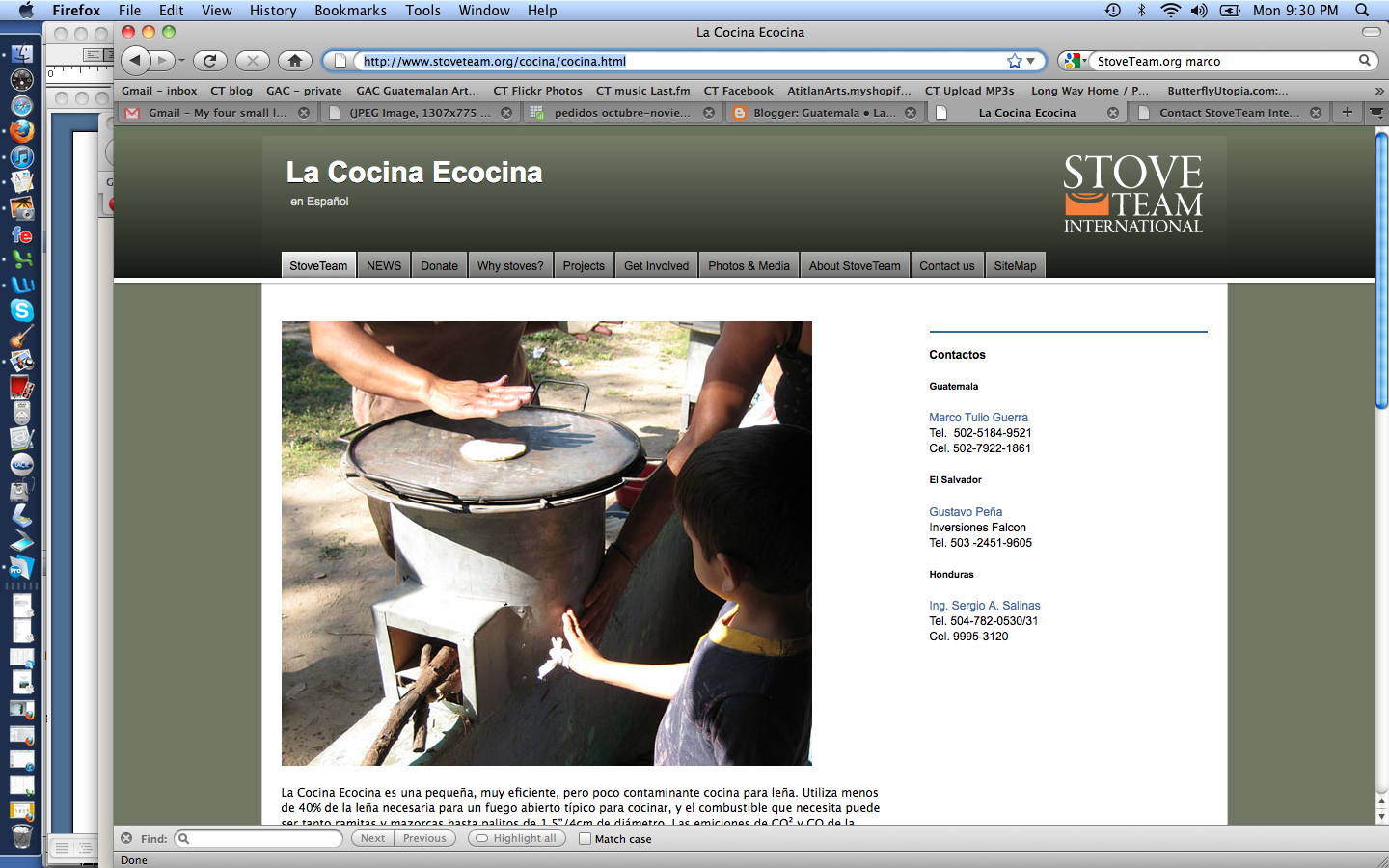
Onil Stoves ~ uses significantly reduced wood for cooking in developing countries


The Ecocina_550 Model, from StoveTeam.org

www.stoveteam.org/why/why.html

The Problem


In the late 1980’s, medical teams reported an alarming number of children being treated for burns and respiratory problems. A number of concerned volunteers found the problem emanated from the way people cooked.

Most of the poor continue to cook over indoor fires located on the floors of unventilated homes. These fires cause debilitating burns, skin and eye problems.

Excessive smoke in homes results in respiratory problems that, according to the World Health Organization, are the leading cause of death in children under the age of five. Testing of carbon monoxide, a deadly toxin, found readings in the homes to be as much as twice the level considered dangerous.

These inefficient open fires also result in massive deforestation.

The Solution


After an exhaustive investigation of the cultural and technological factors surrounding open fires, the new, fuel-efficient Ecocina stove was developed by StoveTeam International. It is economical to build and operate, saving up to 60% of the wood currently used while also reducing particulate matter and carbon output by 70% ... (more)


* StoveTeam
* NEWS
* Donate
* Why stoves?
* Projects
* Get Involved
* Photos & Media
* About StoveTeam
* Contact us
* SiteMap

The Ecocina_550 Model

ECOCINE Kitchen is a small, highly efficient, but less polluting fuel kitchen. Uses less than 40% of the wood needed for a typical open fire for cooking, and fuel needs can be both twigs and sticks ears to 1.5 "/ 4cm in diameter. The emiciones CO CO ² and the ECOCINE are approximately 10% of typical emiciones an open fire. These results have been verified in an independent study done to so require the EPA to take Research Center. The kitchen is ECOCINE principle, a well tested, but not patent 'rocket elbow'. The kitchen incorporates several improvements ECOCINE meaning.

---

Note: Onil Stoves use so much less wood for fuel that they are preventing burns in children and smoke inhalation by family members, are saving forests and trees and preventing erosion and mudslides, and are given out around Guatemala and other developing countries where many still cook with wood. I think the people have to pay 1/2, perhaps Q 860 ($100 US), but Grupo International will help when they can by contributing around Q350 and they come up with the rest. It's a excellent program. I helped pay for one for my landlady in Panajachel, and it works GREAT.

See StoveTeam.org or contact Marco Tulio Guerra, 502-5184-9521, cel 502-7922-1861.

---
ONIL STOVES

La Cocina Ecocina - StoveTeam
La Cocina Ecocina. en Español. StoveTeam · NEWS · Donate · Why stoves? .... Contactos. Guatemala. Marco Tulio Guerra Tel. 502-5184-9521. Cel. 502-7922-1861 ...
www.stoveteam.org/cocina/cocina.html

StoveTeam International News
In Guatemala, Marco Tulio's factory is gearing up for production. .... StoveTeam International a 501(c)(3) organization. PO Box 51025. Eugene, OR 97405 ...
www.stoveteam.org/news/news.php

StoveTeam International News
Marco Tulio's factory in Guatemala is beautiful and up and running. .... StoveTeam International a 501(c)(3) organization. PO Box 51025. Eugene, OR 97405 ...
www.stoveteam.org/news/news.php

Contact:

Guatemala
Marco Tulio Guerra
Tel. 502-5184-9521
Cel. 502-7922-1861

El Salvador
Gustavo Peña
Inversiones Falcon
Tel. 503 -2451-9605

Honduras
Ing. Sergio A. Salinas
Tel. 504-782-0530/31
Cel. 9995-3120

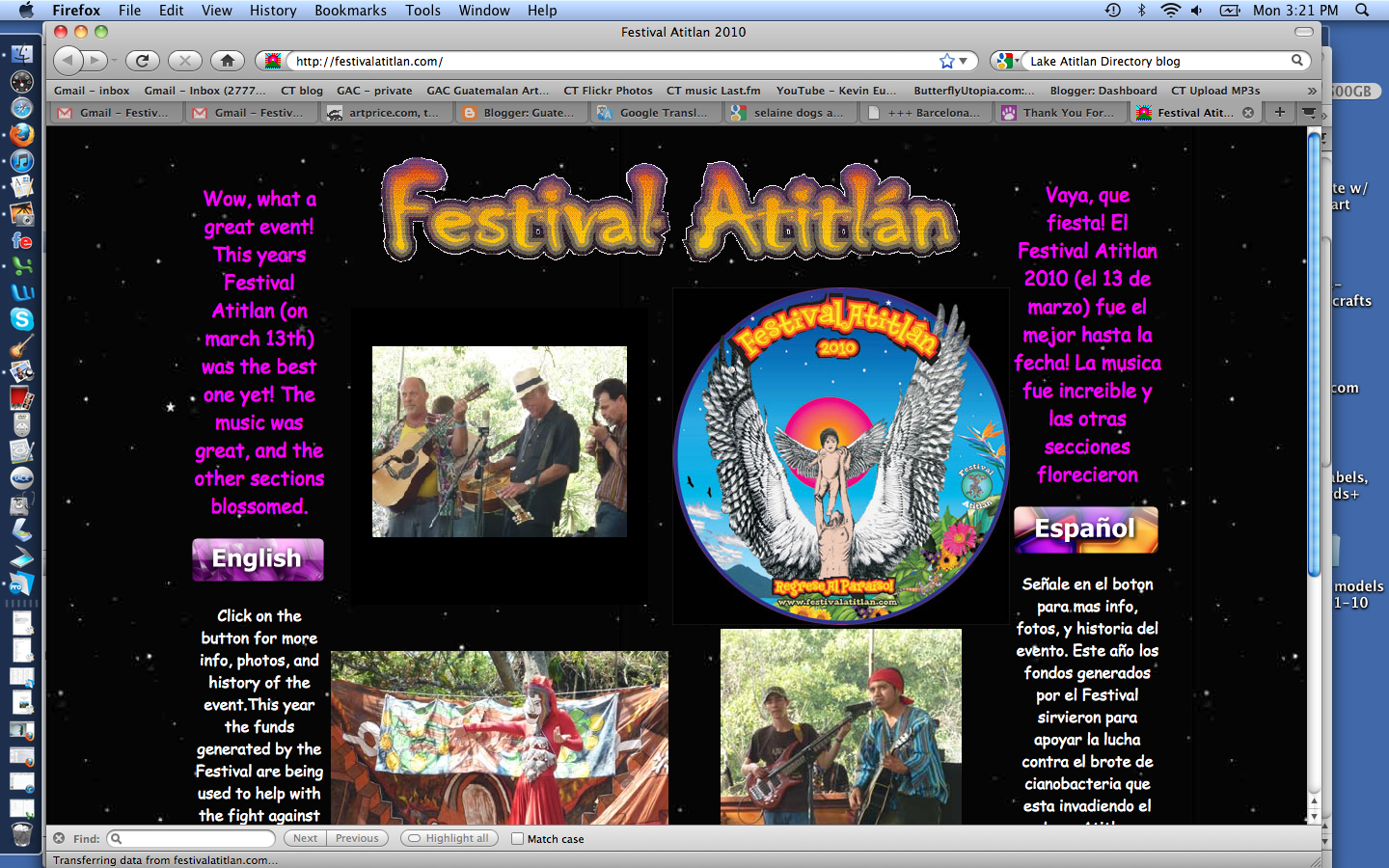
Festival Atitlan 2011 ~ March 19, 2011


FestivalAtitlan.com

Roberto Luz Mon, Nov 8, 2010 at 1:30 PM

Dear Friends:

March 19, 2011 will mark the 10th anniversary of the Festival Atitlán.
We have gradually been changing and improving things over the years, and have evolved into a very special and unique event. With your help we plan on making this the best one yet. It's time to start moving energies and putting together the threads that will be the Lake Atitlan International Music and Arts Festival 2011.

Although we are growing, it is very important to maintain the festival atmosphere of peace, brotherhood, positivism, and the spirit of cultural and social exchange where we can gather with people of all races to celebrate the great diversity and to share the flowers of our diverse cultures. At the same time it is necessary to continue the philosophy of using the funds generated by the event to support local projects that will improve life on Lake Atitlán. It’s proof that regular folks can unite to cooperate and achieve improvements in the future of all people. Artistic activism. The festival will always remain a nonprofit event. If the event was commercial, it just wouldn’t work.

Every year we have grown, and we had more than 1000 participants in 2010. To date, the Festival has maintained itself exclusively with the sale of tickets (a donation of Q100 for "visitors" and Q50 for "locals") and labor donated by the organizers and participants. To produce a festival of this kind field it is necessary to build a temporary village with all its services, and then make it disappear and return the forest to its natural state.

For 2011, we decided to seek economic and logistical assistance to achieve improvements to help ensure that the Festival continues to make progress. This is the help we are looking for:

1. The biggest discussion we have been having between this year organizers is about whether we should extend the festival to two days. This would allow more performers to participate, and also give us more time for the non-musical arts and the children section.

What has prevented us from having a two day event in the past is simply the lack of economic resources to pay for a second day’s rent on the sound equipment. This year there are rumors of finding money for the equipment, but a second day means doubling the infrastructure (health, security and control, accounting, etc.) It would be necessary to hire extra staff for those positions.

2. We are expecting more people in 2011, and we have been using the same composting toilets for 5 years, we need to build more.

3. As always, we need art materials for the children’s section.

4. All artists and organizers participating in the Atitlán Festival donate their art and time. The festival takes responsibility for their room and board, and traditionally we have supported them with a small incentive to pay for gasoline. We have had offers from top quality national and international musicians who only seek the money to get them here, and we had to refuse because of lack of funds. These groups include "Congreso" from Chile, "Toots and the Maytals" from Jamaica, Buffy StMarie from Canada, and "Sobrevivencia" from Guatemala. In 2011 I am trying to bring a Native American dance troupe from the United States, complete with drums, costumes, and paint… a genuine exchange cultural.

5. In the past our lack of resources limited the amount of propaganda, and I am sure that, with further support from the press and with paid newspaper ads we would attract more viewers. If you have connections with the press, please help us.

6. Our eco-project on the cyanobacteria problem, which we began in 2010, is producing ecological and cultural educational materials. We have produced and we're handing out 5000 copies of the first eco-comic, which is for adults: "Ixim Acha o Ciano Acha…Que Puedo hacer yo Para Eliminar la Cianobacteria en el Lago Atitlán", and we are in the process of finishing a tale for children: "Berta Basura", which will be published in December. We are looking for money to produce the second edition of Cianoacha…. In addition, in November the first wave of mini eco-videos (mostly on the cyanobacteria) that we have been preparing to give to the cable stations around the Lake is ready. If you have connections with any of these stations, please connect us. You can see some examples of these projects on their page on our internet site: www.festivalatitlan.com/cyanobacteria/cyanobacteria.html

Apart from economic help Festival Atitlán we need lots of help in all phases of the project, from organization to trash. In 2010 there were more than 80 people who helped produce the show, and if we have a two day event we will need more. We are in the process of developing a complete jobs list. I will send it to you when it’s ready.

And finally, I want to make a call to all musicians, dancers, actors, poets, clowns and artists of all kinds to come to share your art and good energy and help Festival Atitlán 2011 to be the best event of the year.

Roberto Luz , festivalatitlan.com


Catherine S. Todd Mon, Nov 8, 2010 at 4:19 PM
To: Roberto Luz
Two days would be GREAT. How much is needed for the second day's rent on the sound equipment? What we can do to help the cyanobacteria is imperative. Thank you for all you good work for the festival and the lake! Looking forward to an update, and posting this on my Lake Atitlan Directory blog. LakeAtitlan.blogspot.com

Yours, Catherine Todd (contact and links below)

Vote for "A Class Apart, Guatemala" on the BBC World Challenge

Note: Vote for "A Class Apart, Guatemala" on the BBC World Challenge. Same group, different name. THANKS! CT

A class apart - Guatemala - World Challenge 10
Mateo Paneitz went to Comalapa, Guatemala, in 2003 as a Peace Corps volunteer. Peneitz's desire to help this impoverished, predominantly Mayan community ...
www.theworldchallenge.co.uk/2010-finalists-project06.php


A Class Apart - World Challenge 10
Long Way Home – A Class Apart – Alexandra Posada - Guatemala. 27-09-2010 ...
www.theworldchallenge.co.uk/producer-project06.php

---

Vote for Long Way Home in The World Challenge.co.uk before 12th November 2010!

I just got back from visiting LongWayHomeInc.org in San Juan Comalapa, Guatemala, who are building the most beautiful and incredible technical school with recycled materials including tires, earth bags and plastic bottle "bricks" filled with dirt or sand. This project is just stunning and they are going to help us do the same thing here in Panajachel, Guatemala.

The school is so beautiful with arched doors and windows and an arched ceiling, and colored glass bottles in the ceilings and walls with the sunlight shining through. Once the walls are plastered over you would never know it was made with rammed earth tires and bottle "bricks." This is definitely the wave of the future for green building!

This will change everything, and make such a huge difference for people who have lost their houses in the last three hurricanes that have hit Lake Atitlan, as people will learn how to build with free materials clogging the landfills or contaminating the rivers. Long Way Home is training people to build with these techniques. I can't wait to begin myself! We will work with them as partners to build a technical school, with art, music and computer classes as well in 2011. We're gathering free materials to recycle starting today, "as we speak."

Long Way Home needs votes right away for their excellent building project, as they have been chosen as one of the 2010 FINALISTS out of thousands of entries!

Voting closes 12th November 2010. www.theworldchallenge.co.uk/vote_2010.php

Can you vote for them and pass this along? They are an excellent group that are helping to change the world. I promised to get twenty votes before voting closes, so here you go...

Long Way Home / Welcome!
Vote Online for Long Way Home in the BBC World Challenge: Education, Employment, and Breaking the ... Follow longwayhomeinc. Content © by Long Way Home ...
www.longwayhomeinc.org/,
contact by email:"Genevieve Croker" ,

See their video: http://www.youtube.com/watch?v=WGt3sY54vyg&feature=player_embedded

Then Vote! http://www.theworldchallenge.co.uk/, www.theworldchallenge.co.uk/vote_2010.php

THANK YOU.

Catherine Todd


--
Catherine Todd
3007 Bent Tree Dr. Oxford NC 27565
H 919.693.0853 U.S. cell 919.605.0727

"The winds of grace blow all the time. All we need do is set our sails."
"Los vientos del golpe de gracia todo el tiempo. Todo lo que necesitamos hacer es establecer nuestras velas."

“The world is a book and those who do not travel read only one page.” - St. Augustine

"Peace and justice are goals for man." - Martin Luther King

Blog: http://catherinetodd.blogspot.com/
Music: http://www.last.fm/music/Catherine+Todd
Photos: http://www.flickr.com/photos/catherinetodd/sets/

Guatemalan Arts & Crafts (GAC)
Panajachel, Lake Atitlan
Guatemala cell (dial 011 from the U.S.):
(502) 5013.6300
Travel: http://lakeatitlan.blogspot.com/
Architecture: http://catherinetoddarchitecture.blogspot.com/

Wednesday, November 3, 2010

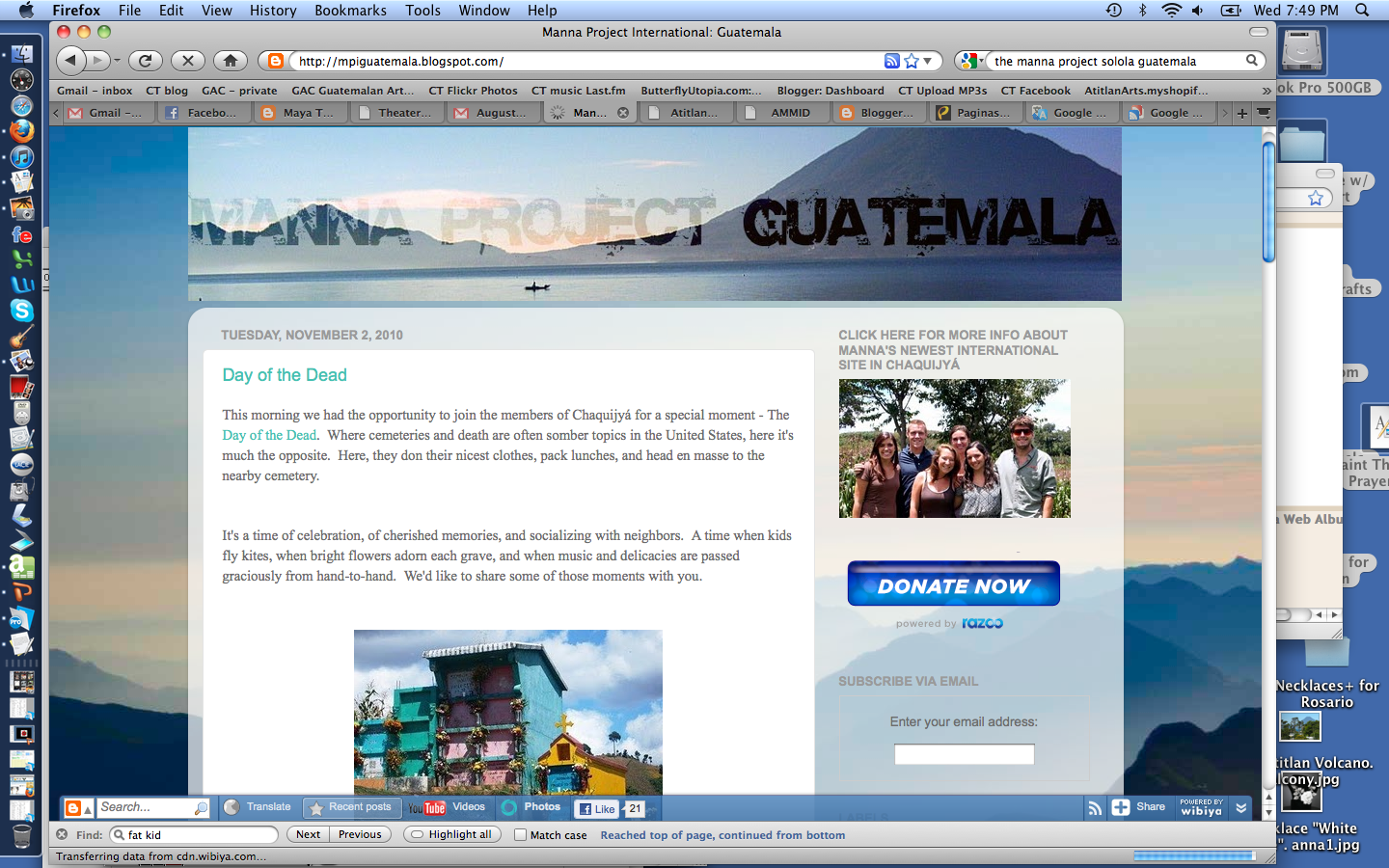
MPI Guatemala | Manna Project International


Manna Project International: Guatemala: Yo no se manana

Manna Project International: Guatemala. Friday, August 6, 2010. Yo no se manana. ¡Bienvenidos from MPI Guatemala's new house in Sololá! ...
mpiguatemala.blogspot.com/2010/08/yo-no-se-manana.html

Manna Project International: Guatemala

2 Nov 2010 ... Manna Project International: Guatemala .... Send mail to our new home at: MPI Apartado Postal #5. Solola 07001. Guatemala ...
mpiguatemala.blogspot.com

Manna Project International: Guatemala: Guatemala welcomes Hillary ...

5 Mar 2010 ... Manna Project International: Guatemala ... Now we are in Sololá, well actually 10 minutes away in nearby Panajachel. ...
mpiguatemala.blogspot.com/.../guatemala-welcomes-hillary-clinton.html

MPI Guatemala | Manna Project International

Help Manna Project Grow: Become an MPI Guatemala Founding Donor Today ... from Guatemala City, the community lies within the department of Sololá, ...
www.mannaproject.org/guatemala