Showing posts with label Raimundas Malasauskas. Show all posts

Tuesday, February 1, 2011

TWO LITHUANIANS AND A PALESTINIAN WALK INTO A ROOM FULL OF MEXICANS. 7 OBSERVATIONS ON THE EXHIBITION 'INTO THE BELLY OF A DOVE'


Two Lithuanians and a Palestinian Walk into a Room Full of Mexicans. 7 Observations

1.
Would the generalization, sometimes exhibitions work like a cartoon, sound more like phlegm or like a decorous distinction, like comparing a man with a dog? Is your inclination to think that cartoons and exhibitions share conventions: the involvement of known set ups, the stock characters, the punchlines dependent on an audiences familiarity with the popularized ailments of those ‘stock characters’, and that audiences willingness to prolong some easy ethnographic arithmetic and the safety we take in generalizations, or are you inclined to see this analogy as a way to draw out the distinction that cartoons and exhibitions can be an escape from prediction?

2.
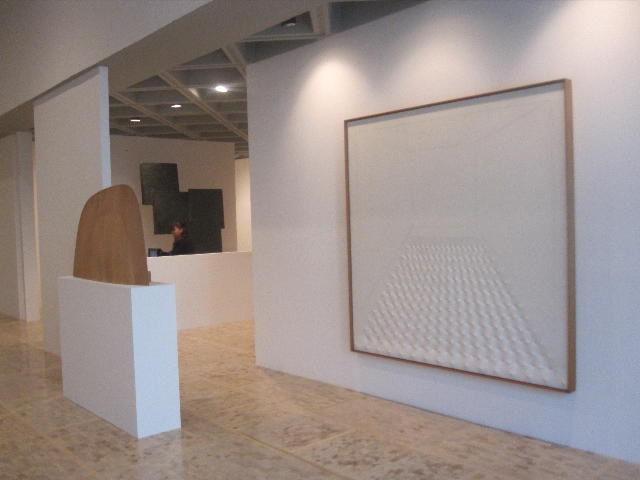
In April, Raimundas Malašauskas, Gintaras Didžiapetris, and Rosalind Nashashibi curated Into the Belly of a Dove (ITBOAD) as part of the Museo Rufino Tamayo’s new series Activating The Collection. The premise was to shrink a closed wing of the museum to 1/20th the scale, and insert the shrunken reconstruction full of art into another wing of the Museum.

3.
Unlike a lot of museum exhibitions, ITBOAD was not anchored around the normal banners that we disputatious trust to establish meaning-The Isms. Generation. Geography. Historical imperative. Cultural context. Critical response, etc. While the show was full of doors and hallways, it did not exist in a place of logical expectation: this is where I’ll go, this is what I will see, this is the conversation we will have. It had the looser physics of a cartoon: the same non-sense rule that can walk a horse into the bar of a joke, seemed to bring the artists to the walls of ITBOAD. From obscure Mexican artists and name brand modernist’s Helen Frankenthaler, David Smith, Jean Dubuffet, Lynn Russell Chadwick and some outliers like Saul Steinberg.

4.
Over the phone once, Saul Steinberg, said, “I realized today: the umbrella and the bicycle are the two perfect things that we cannot make for ourselves. We know how they work, we follow their operation, but we cannot make them, even with effort. Very simple, but we are stumped. So now I realize why the umbrella and the bicycle are so common in modern art. Picasso. Duchamp’s wheel. Leger’s umbrellas. Magritte. It is because this is the only honest review we can give the modern artist. Very simple, but we are stumped.”

5.
It was meta-post-something, but not with the narcissistic malignancy these things-about-their own thing-ness usually have. The addiction to rendering something in a manner that foregrounds the rendering, not the something, gets old fast, but fortunately the curators of ITBOAD, though indebted to Finnegan’s Wake, Borges’ bent forks and Bertolt Brecht’s LOOK! LOOK!, didn’t seem all that concerned with the cleverness of their own lilliputious set up, but instead more fixated on “making a form strange in order to resist both one's own preconceptions and the weight of others opinions.”(to paraphrase Italo Calvino). Slight difference perhaps. Point is: what was made strange was not so much the work, but the experience of being in a museum. This is the Brecht part, the part about feeling hyper aware of the set-up which in a museum is as interesting as it is redundant. It’s redundant because museums- and their crest-clean walls, fluorescent hum, and alien digs-never let you forget you are in a museum. In them, I’m hyper-aware that I’m in an emotionally exempt space that feels like a shopping mall or an airport or a shopping mall in an airport. It’s like being in a big set of parenthesis. The academic-blowhard term for this architecture of nowhere is ‘non-space’. The awareness of being in ‘non-space’ is amplified in the Tamayo because the museum is highly contrastable with the rest of Mexico City. Mexico City is everything the museum isn’t. It’s chaotically organized and congested and dirty, and when your inside the museum you feel as much in Mexico City as you do say in Geneva or the Container Store in midtown Manhattan.

6.
I mentioned above, some funnels that critics and viewers use to give work meaning. It’s inviting for viewers to seek these family resemblances, and I’m not sure we’re in the wrong to do so, but funneling it this way can spur a dependence on the funnel as a first line of defense, but ITBOAD, for me (a stuttering first time art-critic) is hard to talk about because it seems to resist all the things we critics use to give our words traction.

7.
It is sometimes possible to define the depth of an experience by means of how radically it ties your tongue or hastens your verbal motor skills. In The Power of Myth, a taped conversation with Bill Moyers, Joseph Campbell discusses the first, second, and third best talking pts., “The first best things we can’t talk about because we don’t have words for them. The second best things we talk about are our attempts to talk about the first best things, and the third best thing to talk about is all the other stuff to talk about.”

We log most of our larynx time in this third tier, not because we are putatively inarticulate or braindead, but because of the alluring convenience, all you need is a tongue and a wall. The third tier is the folksy byway where we fill space.

The second tier, the hiccoughs, “the second best things we talk about are our attempts to talk about the first best things” is where it seems most people who try to articulate the less haptic do most of their living. Perhaps, better said by a friend, “Dude, explaining why art is good is like explaining why a joke is funny.” For me, like ITBOAD, the better kind of art, the stuff that hangs around in my gut, is such a close call with nonsense that it almost precludes the kind of sorting that language facilitates. I’ve heard that these shows about museum collections say more about the person who selects the work than the work itself. If I was hogtied into making a confession, I’d blurb that whatever decisions Malašauskas/Didžiapetris/Nashashibi made followed the principals of dream construction, which means decisions occurred in the absence of reason, in the pre-verbal and thoroughly flawed bar of a cartoon.

Robert Snowden, 2010

originally printed in http://blunt.cc/531276/notebooks/2/two-lithuanians-and-a-palestinian-walk-into-a-room-full-of-mexicans.-7-observations

See the exhibition here:
http://centrefortheaestheticrevolution.blogspot.com/2010/04/raimundas-malasauskas-with-rosalind.html

Monday, July 5, 2010

MARDI IS A CHARACTER ON 'REPETITION ISLAND' AND WILL BE APPEARING AT CENTRE POMPIDOU IN PARIS FROM THE 7-12 OF JULY

Perhaps this is not a portrait of Mardi that you are expecting. Mardi is fine and will come back tomorrow, or later today, straight from the writing desk of those exquisite minds blowing it out of the thin air for you. What I would like to share is a schedule of Mardi's inhabited Repetition Island* that will take place 7 - 12 July at Centre Pompidou in Paris. It is a scenario of one day that will be attempted by its participants to exercise over again and over again for six subsequent days. “Maybe the last day will look like the first day was intended to be,” Mardi explains.

I am excited to think that we can spend this day together, so please come twice at least. And follow it on www.repetition-island.com

11:00 — 12:00
To create the space for the rest of things to happen, Morten Norbye Halvorsen switches microphones on and the voice of Richard Foreman appears in a suit jacket, tailored by Jessica Warboys. Yesterday is replayed, tomorrow is pre-recorded, today is spaced out, tapping time on the shoulder

12:00
Benjamin Seror appears with a portable model of the basement level of the Centre Pompidou. He uses it to explain visitors where they are located. This makes him to tell stories about time and space troubles or the difficulties to get from a point A to a point B on time.

11:30 — 12:30
Invited by Ana Prvacki, a number of professional, amateur and all music students come and do their daily practice of scales, tonal and finger exercises while strolling and wandering through the space of Repetition Island. 'Wandering Band' is the opposite of a marching band, it is an informal musical gathering, a 2 in 1, practice and visual art education.

12:30
Musicians abandon the space to explore he rest of the Centre, the electro-mechanics arrive to attend the final reviewing stage of the introductory philosophy class conducted during last year by Lorenzo Cirrincione. It ranges from the subject of truth in psychology to Plato's politics. A sharp arrival is important for anyone wanting to attend the class (in French)

14:00 — 16:00
Geraldine Longueville with students of Ecole Nationale Supérieure d’Arts-Paris Cergy (ENSAPC) Nicolas Carrier, Luc Kheramand, Gloria Maso, Flora Moscovici, Laura Porter, Sébastien Remy, Nicholas Vargelis and Cyril Verde continue experiments in producing a collective artwork called 'Eight Days a Week (Le Signal Wapo)' (in French.) Several visitors are examining the holes of Something Less, Something More, an artwork of Pierre Bismuth that became a scenography of Repetition Island.

Around the same time Sam Durant will explain some theories of anarchism to his daughter: "Inspired by Courbet’s painting of Pierre Joseph Proudhon and his children I will talk with my daughter about current events while feeding her lunch."

15:00 — 15:30
Ieva Miseviciute and Michael Portnoy are reenacting the complete history of Obdurance Art, from 1860 til the present, in 30 minutes.

16:00 — 17:00
Manon de Boer film Sylvia Kristel-Paris is being screened (in English.)

17:10 — 17:25
Audrey Cottin Paris Clapping Group deliver a clapping session where everybody can participate.

17:30
Michael Portnoy starts his artist's presentation, but it ends up abruptly. Giraud and Siboni pick it up and try to undermine the whole night, or the whole day, with their Spoiler session (in French and English)

18:30 — 19:00
Adva Zakai performs 'Regarding Yesterday' and attempts to distill thoughts which float around while the show takes place. If she succeeds – today’s thoughts will become tomorrows performance (in English)

19:00 — 20:30
Hypnotic Show with Marcos Lutyens in La Petite Salle: visitors experience a virtual exhibition in the state of hypnosis (in French and English)

19:00 — 20:00
'L'éternuement et punir' (Sneeze and Punishment) presentation by Aaron Schuster (in French) about cinema, sneezing and series of thoughts

19:45 — 20:30
Gabriel Lester meets his daily guest at a round table (in French and English)

20:20
Gintaras Didziapetris and Rosalind Nashashibi's stage a short event involving two middle-aged actors taking a choreographed walk through the show as a loose illustration of their relationship to each other whilst simultaneously being and having audience, and as an expression of emotions through various filters such as mask (persona, confrontation and withdrawal, entry and return), and music (comment, theme, pause, trip).

20:30 — 21:00
Geraldine Longueville and Benjamin Seror tries to wrap up the day with the karaoke version of 'Without a Song' by Frank Sinatra ("Without a song a day would never end" chorus adds, Morten Norbye Halvorsen seals the tapes, a song is carried outside.)

Also:
Gabriel Lester acts as continuity supervisor, Michael Portnoy is an attention thief, Audrey Cottin is at multiple spots at the same time, Mardi is kicking on Twitter, Julia and Lucien are wearing t-shirts by Marie de Brugerolle, Olivier Babin is back, Mont Analogue appears as Hapax!

* Repetition Island is also a title of the first full-length film by Benoît Maire: “repetition island”, super 8, 68 min, 2010

Mardi is a character on Repetition Island.
You will be receiving a different portrait of Mardi created by a writer or an artist daily.
Together with other characters Mardi will be appearing 7 - 12 July at Centre Pompidou, Paris.

Wednesday, April 21, 2010

RAIMUNDAS MALASAUSKAS WITH ROSALIND NASHASHIBI AND GINTARAS DIDZIAPETRIS 'INTO THE BELLY OF A DOVE' A RE-READING OF THE TAMAYO COLLECTION


Activating the Collection is a series of exhibitions that reflects on and reactivates the art collection of Museo Tamayo. Its axis is thematic and interpretative, inclusive of straight or performative, discursive or visual, artistic or heavily-designed approaches to curating and exhibition making. The first exhibition in this series is 'Into the Belly of a Dove', guest curated by Raimundas Malašaukas, in collaboration with artists Gintaras Didžiapetris and Rosalind Nashashibi; it's organized at Museo Tamayo by associate curator Daniela Pérez. 'Into the Belly of a Dove' is based on the premise that everything is possible and nothing is real. It includes seminal artworks by Lynn Russell Chadwick, Helen Frankenthaler, Christo, Giorgio de Chirico, Jean Dubuffet, Joan Miró, Giuseppe Rivadossi, among others.

The exhibition space is a reconstruction in a smaller scale of the spaces in Museo Tamayo which are currently closed for refurbishment. It is a negotiation of scales, times and appearances. It can recall a film studio in which a cast of works of art fro the collection of the museum is brought together to transverse destinies and chronologies. 'Into the Belly of a Dove' offers, in addition to a staging of works from the collection, a close relationship with the archive images of these pieces, as well as the presentation of new photographic records that show etheir possible future. So finally not only the idea or possibility of the show as a cinematographic set or a photographic studio is exciting, it allows the works to perform simultaneously in the before and after in one same space; the staging of works and the photographs produced are caught together and forever in the twist of the maze.

Friday, October 2, 2009

RAIMUNDAS MALASAUSKAS PRESENTS: 'SCULPTURES OF THE SPACE AGE'


letter handed to the visitors of the exhibition (above)


Curators’ Series #2.
Sculpture Of The Space Age
curated by Raimundas Malasauskas
Exhibition dates: 02.10.2009– 19.12.2009
Opening Reception: 01.10.2009 from 6.30pm

Developed over the last year, Raimundas Malasauskas’s group exhibition Sculpture of the Space Age refers to an exhibition mentioned in J. G. Ballard’s short story The Object of the Attack (1984). Not detailed in the text, the exhibition was supposedly held at the Serpentine Gallery in the early 80’s and exists only as a title in the story.

Malasauskas writes “Sculpture of the Space Age is less than 30 years old, but very few can remember precisely what it was about. Perhaps its content is actually outside of the exhibition. This insight is very specific of the novel’s main character Matthew Young’s tendency of space-time denying. Mr Young, who got fined for being disorderly at the opening of Sculpture of the Space Age at the Serpentine Gallery in the early 80s, is the only person known to have attended the opening that night. When in the 90s two British artists, Graham Gussin and Jeremy Millar, came across this fictional exhibition mentioned in Ballard’s short story, they got carried away by the idea of translating the exhibition from the space of the story to the space of the gallery. This curatorial premise led them to a conversation with the author J.G. Ballard who suggested a few artists who could have been in the show, although none have been mentioned in the original narrative. Despite the exciting curatorial process Sculpture of the Space Age did not open at the Serpentine Gallery in London in the 90s as Graham Gussin and Jeremy Millar intended. Their time-travelling experiment of making an exhibition turned into an archive, which is now stored in a cardboard box.

Sculpture of the Space Age became an anachronism that keeps living on its own ambivalence as something that could have happened, then almost happened again. It openly contains its own possibility and impossibility, as this new diversion suggests: Mario Garcia Torres with Ryan Gander and Gintaras Didziapetris with Rosalind Nashashibi bring Sculpture of the Space Age to where it could have been and where it has never been yet: the year 2009. The show looks as if it was installed in the early 80s, but will open its door only tomorrow.”

http://www.davidrobertsartfoundation.com/exhibitions/_24/

http://www.rye.tw/