Showing posts with label Rosalind Nashashibi. Show all posts

Wednesday, April 21, 2010

RAIMUNDAS MALASAUSKAS WITH ROSALIND NASHASHIBI AND GINTARAS DIDZIAPETRIS 'INTO THE BELLY OF A DOVE' A RE-READING OF THE TAMAYO COLLECTION


Activating the Collection is a series of exhibitions that reflects on and reactivates the art collection of Museo Tamayo. Its axis is thematic and interpretative, inclusive of straight or performative, discursive or visual, artistic or heavily-designed approaches to curating and exhibition making. The first exhibition in this series is 'Into the Belly of a Dove', guest curated by Raimundas Malašaukas, in collaboration with artists Gintaras Didžiapetris and Rosalind Nashashibi; it's organized at Museo Tamayo by associate curator Daniela Pérez. 'Into the Belly of a Dove' is based on the premise that everything is possible and nothing is real. It includes seminal artworks by Lynn Russell Chadwick, Helen Frankenthaler, Christo, Giorgio de Chirico, Jean Dubuffet, Joan Miró, Giuseppe Rivadossi, among others.

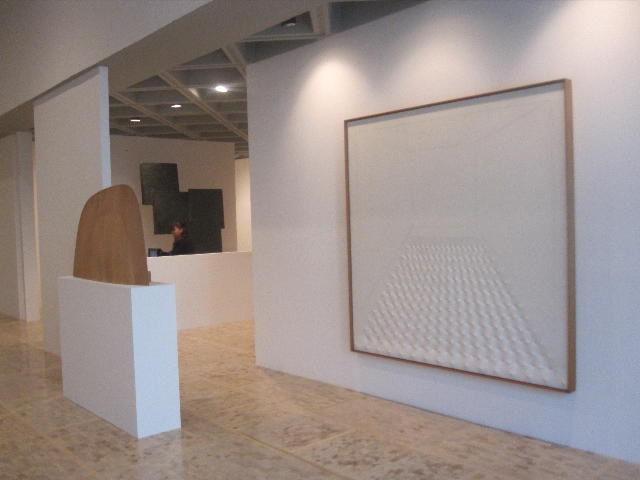
The exhibition space is a reconstruction in a smaller scale of the spaces in Museo Tamayo which are currently closed for refurbishment. It is a negotiation of scales, times and appearances. It can recall a film studio in which a cast of works of art fro the collection of the museum is brought together to transverse destinies and chronologies. 'Into the Belly of a Dove' offers, in addition to a staging of works from the collection, a close relationship with the archive images of these pieces, as well as the presentation of new photographic records that show etheir possible future. So finally not only the idea or possibility of the show as a cinematographic set or a photographic studio is exciting, it allows the works to perform simultaneously in the before and after in one same space; the staging of works and the photographs produced are caught together and forever in the twist of the maze.

Friday, October 2, 2009

RAIMUNDAS MALASAUSKAS PRESENTS: 'SCULPTURES OF THE SPACE AGE'


letter handed to the visitors of the exhibition (above)


Curators’ Series #2.
Sculpture Of The Space Age
curated by Raimundas Malasauskas
Exhibition dates: 02.10.2009– 19.12.2009
Opening Reception: 01.10.2009 from 6.30pm

Developed over the last year, Raimundas Malasauskas’s group exhibition Sculpture of the Space Age refers to an exhibition mentioned in J. G. Ballard’s short story The Object of the Attack (1984). Not detailed in the text, the exhibition was supposedly held at the Serpentine Gallery in the early 80’s and exists only as a title in the story.

Malasauskas writes “Sculpture of the Space Age is less than 30 years old, but very few can remember precisely what it was about. Perhaps its content is actually outside of the exhibition. This insight is very specific of the novel’s main character Matthew Young’s tendency of space-time denying. Mr Young, who got fined for being disorderly at the opening of Sculpture of the Space Age at the Serpentine Gallery in the early 80s, is the only person known to have attended the opening that night. When in the 90s two British artists, Graham Gussin and Jeremy Millar, came across this fictional exhibition mentioned in Ballard’s short story, they got carried away by the idea of translating the exhibition from the space of the story to the space of the gallery. This curatorial premise led them to a conversation with the author J.G. Ballard who suggested a few artists who could have been in the show, although none have been mentioned in the original narrative. Despite the exciting curatorial process Sculpture of the Space Age did not open at the Serpentine Gallery in London in the 90s as Graham Gussin and Jeremy Millar intended. Their time-travelling experiment of making an exhibition turned into an archive, which is now stored in a cardboard box.

Sculpture of the Space Age became an anachronism that keeps living on its own ambivalence as something that could have happened, then almost happened again. It openly contains its own possibility and impossibility, as this new diversion suggests: Mario Garcia Torres with Ryan Gander and Gintaras Didziapetris with Rosalind Nashashibi bring Sculpture of the Space Age to where it could have been and where it has never been yet: the year 2009. The show looks as if it was installed in the early 80s, but will open its door only tomorrow.”

http://www.davidrobertsartfoundation.com/exhibitions/_24/

http://www.rye.tw/

Wednesday, September 9, 2009

ROSALIND NASHASHIBI AT ICA, LONDON


Mark Sladen, director of exhibitions at ICA presenting the exhibition


Rosalind Nashashibi and Francesco Manacorda

(sorry no pictures of the exhibition due to the ICA's very unfriendly no photo policy, if at least they documented properly their own exhibitions and had them available in their website, but like many institutions, they don't...)


Rosalind Nashashibi
10 Sep - 1 Nov 2009

The ICA is pleased to present a solo exhibition by London-based artist Rosalind Nashashibi. This will be the most comprehensive presentation yet of her work, presenting 16mm films from the last four years alongside examples of her photographic output.

The lower gallery has a trio of short, inter-connecting film works, including Eyeballing (2005) which juxtaposes scenes of New York policemen with the anthropomorphic faces that Nashashibi's camera finds in the physical fabric of their city. The upper gallery screens Nashashibi's two most recent films, including Jack Straw's Castle (2009), her most ambitious work to date. The latter uses footage shot in and around a public park, interlacing shots from real life - including sequences shot in a cruising area - with highly theatrical scenarios involving a cast of non-actors.

If Nashashibi's early films were often understood as documentary or anthropological in nature, it is the cinematic aspect of her work that has become increasingly apparent, as well is its engagement with performance and ritual. Many of the works on display here involve elements of staging, and all of them are engaged with personae in human life, and how we transform ourselves through theatre. Such ideas are also evident in a new photographic installation by the artist, In Rehearsal (2009), which depicts what is known as 'physicalisation', whereby people are transformed into characters.