Showing posts with label Lake Atitlan. Show all posts

Tuesday, December 13, 2011

HOW TO WORK TOGETHER FOR LAKE ATITLAN?

From a discussion on Facebook in the open group AMSCLAE:


https://www.facebook.com/pages/AMSCLAE/181121465276992
This is the best explanation of why and how we need to work together: When I am attacked, my immediate reaction is to STRIKE BACK and in a BIG WAY. That's why I don't work with groups. I can't stand it. But here is a situation where we all NEED TO and I WANT TO work for the good of Lake Atitlan, so perhaps I will be able to learn the skills needed to do so. Here is what was written to me that changed EVERYTHING, in just a few words:
Acción Guatemala 11:24am Dec 13, 2011 
Catherine Todd ... please don´t go just because of one person. if Maximo wants to be nice and make better translations, he should do it himself and we will all be grateful. If he can´t, then there might be another solution... we should all have a little patience. We are a community of many languages and we really need to share information"
God works in mysterious ways. Ever since I decided to do the LakeAtitlanDirectory.com which is simple, free online database listing all the community groups and services around Lake Atitlan, I have been subject to the most incredible rudeness and attacks by a few individuals. It's been enough for me to seriously consider shutting down the whole thing. But then I see something like what Acción Guatemala writes, and I see the problems when people can't or won't work together for the common good, and I realize that I have contributed to conflict myself by my immediate gut reaction of striking back, so I will give it another try.

I hope I can learn new skills at this late stage. If not, I will continue to work from the sidelines and provide what is necessary and remain in my small cloistered monastery where I do find peace. But the whole wide world is awaiting outside in all it's conflict and cacophony and I can't hide away here forever. It's time to save Lake Atitlan and that will take concerted effort of everyone working together.

The problems with Lake Atitlan are but a serious SYMPTOM of the lack of care that everyone who lives here has shown for the environment, whether it is by ignorance, or impotence, or incompetence; or ego, graft, corruption and greed. Many of us, like myself, don't know what to do and we are trying to find out. I hope everyone will help towards a common goal for the common good. It should be easy but it's not. I will never know why.

Dear God please show us The Way.

"The winds of grace blow all the time; all we need do is set our sails."

Sunday, November 27, 2011

Energies of Place ~ Lake Atitlan


i escaped the clutches of the lake, or that is the way it feels. Felt it dragging me to its depths at times, to that which lay below and within. At times it shown brightly at me, like the day i watched the sun or something sparkle upon it, in lines and geometric designs and across [...]
Read Full Post »

Monday, November 21, 2011

Gringos in Guatemala


Great blog I stumbled across by a new teacher at Life School in Panajachel. We helped Life School redo their computer lab a couple of years back:

Gringos in Guatemala ~ GuatemalaGringo.blogspot.com

http://guatemalagringo.blogspot.com/

Saturday, February 5, 2011

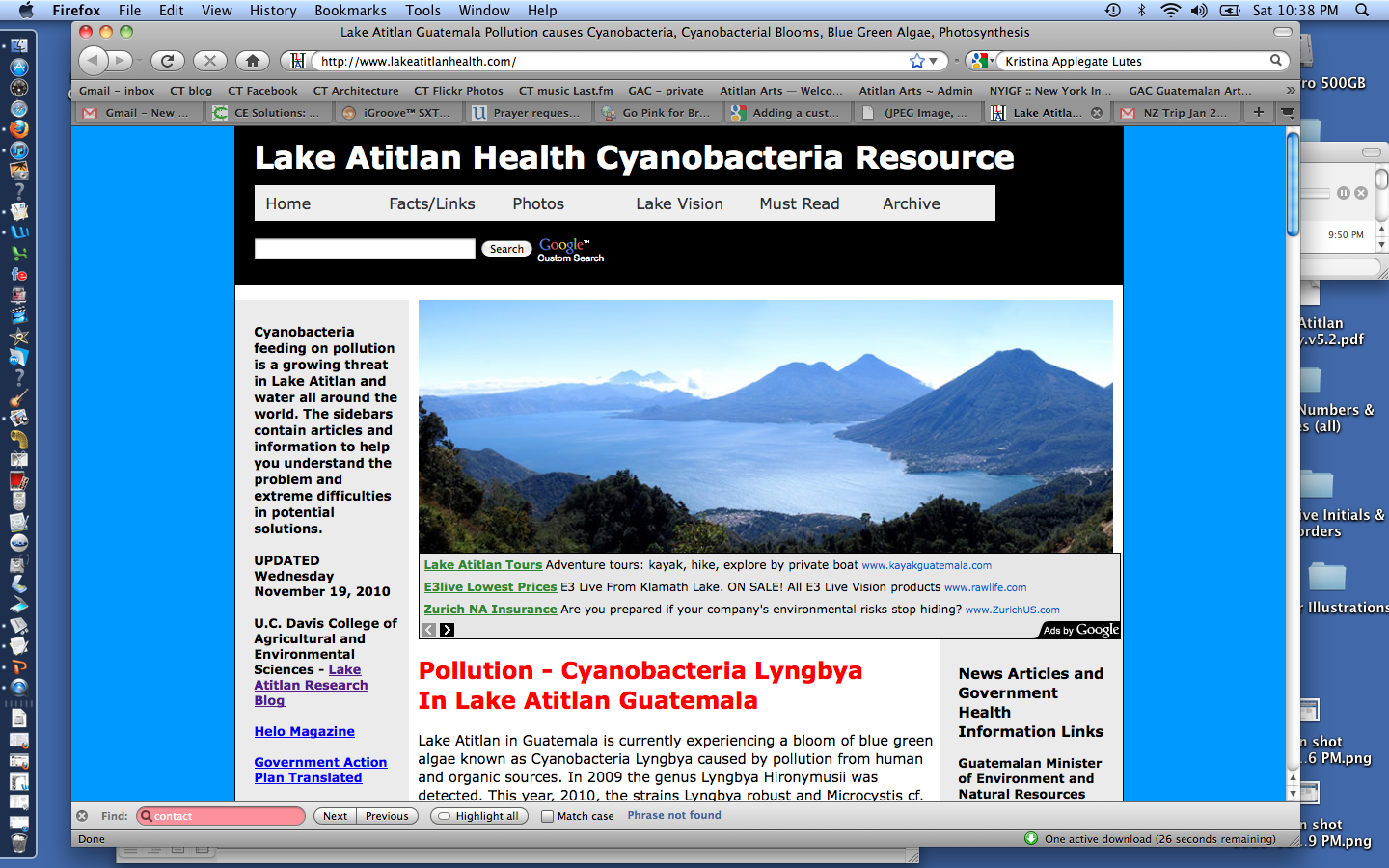
Lake Atitlan Health Cyanobacteria Resource

2.5.11: Anyone heard of any updates from here? This is an udated entry, but it appears to have been posted in Fall 2010. CT


Pollution - Cyanobacteria Lyngbya
In Lake Atitlan Guatemala

Lake Atitlan in Guatemala is currently experiencing a bloom of blue green algae known as Cyanobacteria Lyngbya caused by pollution from human and organic sources. In 2009 the genus Lyngbya Hironymusii was detected. This year, 2010, the strains Lyngbya robust and Microcystis cf. botrys were detected. The bloom this year is not as severe as last year, and November winds are helping to dissipate it.

Located in the highlands of Guatemala, Lake Atitlan is a scenic wonder and a popular tourist destination in the country of Guatemala. There is a large indigenous population around the lake including Tz'utujil and Kakquichel Maya. Many are subsistence farmers who depend on the lake for all of their drinking water and irrigation. Many others rely on the tourist industry.

Roads To Lake Atitlan are Open

There have been reports that the road into Lake Atitlan is closed. This is only true for the main road in from Solola to Panajachel. That road is closed until January for some needed work. There is an alternate route into Panajachel from Antigua, which is well known by the shuttle drivers. As always, it's safest to travel in daylight only due to changeable conditions.

Regular shuttles are also running from Antigua into San Pedro La Laguna on the othe side of Lake Atitlan. The road into San Pedro is open, but a bit rough in places. The shuttle drivers know it well. If you are driving yourself, then use extreme caution as the road is steep and full of switchbacks.

The lake received a record amount of rain this year which has resulted in many landslides and introduced a large quantity of pollution and new nutrients for the Cyanobacteria to feed on. The level of Lake Atitlan has risen over 3 meters, causing flooding of homes and businesses along the lake shore. The loss in tourist revenue associated with these problems has been very difficult for the many people who depend on it for survival.

Cyanobacteria is a form of blue-green algae naturally occurring in waterways and oceans worldwide. It feeds on pollution from agricultural runoff and human waste. It receives nutrients from the pollution in the form of nitrogen and phosphates in the water. The genus Lyngbya, in Atitlan, contains green pigment chlorophyll which traps the energy of sunlight and enables it to carry on photosynthesis. Most cyanobacteria in small concentrations is generally harmless. When cyanobacteria concentrations increase they can form HAB's or hazardous algal blooms. The toxins produced from a "HAB" can include cyanotoxins that induce everything from mild skin rashes to death of animals in cases of extreme exposure. The toxins from Lyngbya can vary widely over short times and could potentially be highly toxic to dogs who come in contact with the lake.

Another recent development is the appearance of Water Hyacinth in some of the bays of Lake Atitlan. This aquatic plant is highly invasive and can choke waterways quickly.

As of July of this year Health Minister Ludwig Ovalle, and the Deputy Minister of Environment for Guatemala, Enma Diaz held a press conference to report evidence of toxicity of cyanobacteria in humans and asked people around Lake Atitlan to refrain from using the lake water for human consumption, irrigation of crops and to not eat the fish, to avoid possible liver complications. "There is evidence that a low percentage of cyanobacteria has produced a toxin that causes liver damage, diarrhea, skin problems and hepatic encephalopathy, among other diseases," explained Ovalle. There were many cases of severe dermatitis reported around the lake from people who came in direct contact with the cyanobacteria during attempts to "clean" the lake in 2009. This was during the peak bloom, where it had amassed in large quantities.

Both Margaret Dix, a scientist at the Universidad del Valle de Guatemala, and Eliska Rejmankova, a scientist at University of California Davis, agree that the cyanobacteria Lyngbya will return annually for the foreseeable future due to the nutrient load in Lake Atitlan. The current cyanobacterial bloom season starts in early September and lasts through late November. Last year the bloom peaked and covered a large portion of the lake in mid October. Seasonal winds helped break up and dissipate much of the bloom in November.

First International Symposium on Cyanobacteria and Cyanotoxins
September 27-29, 2010 in Guatemala

This symposium held at the end of September has not released any detailed recommendations so far. The Minister of the Environment did release a declaration at the end of the symposium which is reprinted below. One of the clear challenges in monitoring cyanobacteria and cyanotoxins is the lack of laboratories capable of analyzing cyanotoxins rapidly enough to disseminate health warnings to the general public, as is demonstrated by the first declaration of the Symposium on Cyanobacteria and Cyanotoxins.
The symposium was the collaboration of the Agency for International Development USAID United States, the Pan American Health Organization, the Mexican Institute of Water Technology (IMTA), the United Nations Educational, Scientific and Cultural Organization (UNESCO), among others.

(more) http://www.lakeatitlanhealth.com/

Lago de Atitlan Expedition 2010 ~ UC Davis

Feb 2011: Note, has anyone had an update from this research trip? CT

"About Lago de Atitlan Expedition
This 2-week expedition, funded by the US National Science Foundation, brings together experts to understand the ecological processes in Lago de Atitlan and suggest future directions that will further our understanding of the eutrophication in the lake. Our goals are to collaborate with Guatemalan scientists, govt officials, & community groups, and train Guatemalan students to develop local capacity to conserve one of the most beautiful highland tropical lakes in the world."


Lagoatitlan2010.blogspot.com

Friday, April 23, 2010

All were up early this morning to finish closing up the labs, safely store our samples for transport, and leave our “home town” of Panajatchel. [Panajachel]

The drive to Guatemala City was much smoother than we’d expected, given our experience with traffic on the way to Panajatchel. We arrived at the Universidad Rafael Landivar just in time for our final presentation of the trip. In a nearly fully auditorium, we presented an overview of the trip, our preliminary findings, and recommendations for the future.

Charles MacVean, dean of the College of Environmental Sciences and Agriculture, opened the session by reminding us of the importance of science in making good decisions and stressing that collaborations of this type provide great hope for Lago de Atitlan.

Photo: Dean MacVean opening the session


Charles Goldman (UC Davis) spoke next. He shared the experiences of Lake Tahoe, which shares many of the same challenges as Lago de Atitlan. After spending 30+ years working on the lake, Dr. Goldman understands the importance of making a long term commitment to a watershed. The parallels are intended to provide hope in two areas: 1) we can learn from what has been done at Lake Tahoe, and 2) it has been demonstrated that factors that damage deep lakes can be changed.

Photo: Charles Goldman


Eliska Rejmankova (UC Davis) spoke next (in Spanish!) to share more specifics about what the expedition learned during the two week expedition.

Photo: Eliska Rejmankova


Nancy Giron (Universidad Rafael Landivar) continued this part of the presentation and provided a detailed overview of the expedition’s activities. She described the fast paced schedule, an overview of the types of experiments conducted, and underscored that the testing and monitoring of this lake should continue if we are to fully understand the dynamics of this lake.

Margaret Dix (Universidad del Valle) was next at the podium and also stressed that science-based decisions will be critical for ensuring the long term health of Lago de Atitlan.

Overall, the message of today’s presentation was

· The lake is sick, but it’s an early stage sickness

· Options exist for mitigating water quality damage

· Capacity exists in Guatemala to fix these problems

· The international science community is fully engaged

A question and answer session after the presentations yielded great discussion. Questions like: “How do we know it isn’t the effects of Hurricane Stan (2005), rather than direct sewage disposal, that has deteriorated lake quality?” (answer: long term monitoring is critical for answering questions like these), “Can we kill the cyanobacteria?” (answer: not realistic, let’s just manage the lake so it doesn’t get enough nutrients to bloom), and “Can chemical or mechanical treatments be applied?” (answer: no, the lake’s too deep for chemical or mechanical treatments to be viable options), and “Is the cyanobacteria in this lake toxic?” (answer: we don’t think so, but we’ll need to work with the samples more in a full scale laboratory. Attention also needs to be paid to the microsystis, which deserves additional study.)

Photo: Dr. Komarek (far left) answering cyanobacteria and microsystis questions


After a wonderful reception hosted by the university that allowed for conversations filled with future collaborative ideas, we piled back into our busses and traveled to a beautiful home in Guatemala City, hosted by Amigos del Lago.

More on that tomorrow!


Posted by Christine Schmidt at 10:15 AM 2 comments

More: comments and photos at http://lagoatitlan2010.blogspot.com/

Partners of the Americas & Kids Share Workshops at ASOCAMPO, Lake Atitlan, Guatemala


Partners of the Americas & Kids Share Workshops at ASOCAMPO, Lake Atitlan, Guatemala

KidsShareWorkshops | November 30, 2010 | 2 likes, 0 dislikes

Dear friends,

I am pleased to share this video with you of our recent visit to Guatemala on a site investigation. It was a very good choice to go first before teaching which I had wanted to do originally. I personally gained a lot of knowledge and additional appreciation for families living in coffee communities. I also feel strongly about working to help these kids with education because they are the future of the coffee plantations from which we enjoy.

After my visit it became clear to me the best way to make a difference is to assist in building an interactive library, arts education, health and sports programs with the help of Partners of the Americas and other non profit organizations. One of our directors also suggested having the Peace Corps involved the first two years so we could have an ongoing presence. These kids have little exposure to the outside world and I am certain few books from which to learn. We did notice a new school was being built. As far as we know only one organization, Catholic Relief Services, which is supported by Green Mountain Coffee Roasters has an active presence. This community was hit hard not too long ago and lost more than half of its family members. But they are rebuilding and feel proud of their heritage and way of life as you will see in the video.

My hope is that by focusing on this rural community for which my employer GMCR purchases coffee from, other NGO's will take notice and want to give to this coffee community as well. Maybe some of you drink coffee, I do. The US is the largest consumer of coffee so I feel it is important to give back to these kids and their families. They are our future and coffee is always going to be important to many folks as it has for many centuries when it originated out of Ethiopia in the 9th century.

Thank you, Kristina Applegate Lutes; Executive Program Director & Founder
Category:

Education

http://www.youtube.com/watch?v=FuKpU5xUC4o&feature=player_embedded

Monday, January 10, 2011

Carmela Ramos Family in San Jorge, mostacilla group

from Lianne Gonsalves
to "Catherine S. Todd"
cc Aurelio Castano
date Mon, Jan 10, 2011 at 7:35 PM
subject Re: Lianne Gonsalves, author of "Behind the Beads: Mostacilla and Its Impact..."

Wow, this looks amazing! I just sent off an e-mail to the two oldest siblings of the family I worked with (they're the ones on Facebook) and I might shoot off an e-mail to Dr. Wallace as well to see if he's still directly in contact with the family itself. Please feel free to post my paper wherever - anything to raise awareness!

I hope I can get you in contact with the Ramos family in San Jorge (who I stayed with) - when I was there, the mother Carmela, was not only in charge of a mostacilla group, she also appeared to be fairly well respected in the community and helped out at the local clinic.

I'd love the extra work in Guatemala but alas I'm headed back to school when return to the United States - I'm getting a Master's in Public Health at Johns Hopkins. I'm currently working as a Fulbright English Teaching Assistant in Caracas and there are a few other ETAs scattered around the country who I'd be happy to recommend to you - they've all got a command of Spanish and a couple of them are definitely interested in development work...

- Show quoted text -

Behind the Beads: Mostacilla and Its Impact on the Women of San Jorge la Laguna

by Lianne Gonsalves, North Carolina State University, Raleigh NC, USA (written around 2007):

"You know, the people here really love beads as do people all over the world. Beads are something tangible; it inflames their imaginations...” –Surunda Velasquez


Though barely 20 years old, mostacilla (beadwork) has quickly spread across Guatemala, becoming a popular tourist souvenir and export item. Since its arrival to the San Jorge la Laguna, Sololá, Guatemala 15 years ago, mostacilla making has become a source of income for the majority of women and their families in this town. However, lacking a market in which to sell their products, the women of the town instead sell their work to indigenous vendors in neighboring Panajachel and Sololá. These vendors buy the work cheaply, then turn around to resell to tourists (or better yet, export to foreigners), making apparently a significant profit in the process. The women of San Jorge feel they are forced to sell mostacilla to their vendors at extremely low prices, and are unhappy they are unable to do anything about it. The women dream of a unified organization of San Jorge’s mostacilla workers, independent from vendors, with their own access to the tourist and international market. However, too much competition between the women, lack of leadership and lack of foreign support works to ensure that, at least for now, a market in San Jorge will remain just a dream.

Methodology

The methodology for this study relied heavily on the use of open-ended interviews. Starting with members of my immediate host family, I used their references and those of my extended host family members in a snow-balling effect, which eventually allowed me to have extensive, sit-down interviews with 13 women living in different areas of San Jorge. Interviews (all of which were recorded) took place in the homes of these women (or the home of a family member), an environment which was both convenient and comfortable for the informants. At the start of each interview, I began with a ten-question survey, consisting of simple, easy-answer questions that allowed me to gain some basic information about the women I was interviewing (how old they were, how many years they had been doing mostacilla, etc.), let them become comfortable with me, and also provide me with some quantitative data to analyze later.

The interview itself was tailored to the women; women who had been doing mostacilla for close to 15 years were asked more questions about the history of mostacilla in San Jorge, while others who had been identified as the “señoras” of mostacilla work groups were asked more about vendor relations and business. Most interviews lasted about 30 minutes. Outside of San Jorge, I conducted both formal and informal interviews (also open-ended) with a number of mostacilla vendors in Sololá, Santiago, and Panajachel. Some vendors were street-side sellers, selling mostacilla from a small cart while others had established tiendas filled with hundreds of different designs. Depending on how much time the vendor was willing to spare, interviews lasted anywhere from 10 to 35 minutes; these interviews were not recorded.

Click here to download the pdf article: http://faculty.chass.ncsu.edu/wallace/Guate2007%20Gonsalves.pdf

Monday, November 8, 2010

Festival Atitlan 2011 ~ March 19, 2011


FestivalAtitlan.com

Roberto Luz Mon, Nov 8, 2010 at 1:30 PM

Dear Friends:

March 19, 2011 will mark the 10th anniversary of the Festival Atitlán.
We have gradually been changing and improving things over the years, and have evolved into a very special and unique event. With your help we plan on making this the best one yet. It's time to start moving energies and putting together the threads that will be the Lake Atitlan International Music and Arts Festival 2011.

Although we are growing, it is very important to maintain the festival atmosphere of peace, brotherhood, positivism, and the spirit of cultural and social exchange where we can gather with people of all races to celebrate the great diversity and to share the flowers of our diverse cultures. At the same time it is necessary to continue the philosophy of using the funds generated by the event to support local projects that will improve life on Lake Atitlán. It’s proof that regular folks can unite to cooperate and achieve improvements in the future of all people. Artistic activism. The festival will always remain a nonprofit event. If the event was commercial, it just wouldn’t work.

Every year we have grown, and we had more than 1000 participants in 2010. To date, the Festival has maintained itself exclusively with the sale of tickets (a donation of Q100 for "visitors" and Q50 for "locals") and labor donated by the organizers and participants. To produce a festival of this kind field it is necessary to build a temporary village with all its services, and then make it disappear and return the forest to its natural state.

For 2011, we decided to seek economic and logistical assistance to achieve improvements to help ensure that the Festival continues to make progress. This is the help we are looking for:

1. The biggest discussion we have been having between this year organizers is about whether we should extend the festival to two days. This would allow more performers to participate, and also give us more time for the non-musical arts and the children section.

What has prevented us from having a two day event in the past is simply the lack of economic resources to pay for a second day’s rent on the sound equipment. This year there are rumors of finding money for the equipment, but a second day means doubling the infrastructure (health, security and control, accounting, etc.) It would be necessary to hire extra staff for those positions.

2. We are expecting more people in 2011, and we have been using the same composting toilets for 5 years, we need to build more.

3. As always, we need art materials for the children’s section.

4. All artists and organizers participating in the Atitlán Festival donate their art and time. The festival takes responsibility for their room and board, and traditionally we have supported them with a small incentive to pay for gasoline. We have had offers from top quality national and international musicians who only seek the money to get them here, and we had to refuse because of lack of funds. These groups include "Congreso" from Chile, "Toots and the Maytals" from Jamaica, Buffy StMarie from Canada, and "Sobrevivencia" from Guatemala. In 2011 I am trying to bring a Native American dance troupe from the United States, complete with drums, costumes, and paint… a genuine exchange cultural.

5. In the past our lack of resources limited the amount of propaganda, and I am sure that, with further support from the press and with paid newspaper ads we would attract more viewers. If you have connections with the press, please help us.

6. Our eco-project on the cyanobacteria problem, which we began in 2010, is producing ecological and cultural educational materials. We have produced and we're handing out 5000 copies of the first eco-comic, which is for adults: "Ixim Acha o Ciano Acha…Que Puedo hacer yo Para Eliminar la Cianobacteria en el Lago Atitlán", and we are in the process of finishing a tale for children: "Berta Basura", which will be published in December. We are looking for money to produce the second edition of Cianoacha…. In addition, in November the first wave of mini eco-videos (mostly on the cyanobacteria) that we have been preparing to give to the cable stations around the Lake is ready. If you have connections with any of these stations, please connect us. You can see some examples of these projects on their page on our internet site: www.festivalatitlan.com/cyanobacteria/cyanobacteria.html

Apart from economic help Festival Atitlán we need lots of help in all phases of the project, from organization to trash. In 2010 there were more than 80 people who helped produce the show, and if we have a two day event we will need more. We are in the process of developing a complete jobs list. I will send it to you when it’s ready.

And finally, I want to make a call to all musicians, dancers, actors, poets, clowns and artists of all kinds to come to share your art and good energy and help Festival Atitlán 2011 to be the best event of the year.

Roberto Luz , festivalatitlan.com


Catherine S. Todd Mon, Nov 8, 2010 at 4:19 PM
To: Roberto Luz
Two days would be GREAT. How much is needed for the second day's rent on the sound equipment? What we can do to help the cyanobacteria is imperative. Thank you for all you good work for the festival and the lake! Looking forward to an update, and posting this on my Lake Atitlan Directory blog. LakeAtitlan.blogspot.com

Yours, Catherine Todd (contact and links below)

Thursday, September 16, 2010

1er Simposio sobre Cianobacterias, cianotoxinas, el agua y la salud

1er Simposio sobre 
Cianobacterias, cianotoxinas, el agua y la salud

El evento se llevará a cabo en el auditorium de la Universidad Landivar, edificio H, Vista Hermosa III, Campus Central, zona 16. Estacionamiento no. 5, costará Q5.00 todo el día.


Universidad Rafael Landívar
Vista Hermosa III
Campus Central Zona 16
Guatemala City
Tel (+502) 2426-2626 (Extension: 2960 for Auditorium)
(Edificio H, Auditurium)


La inscripción al evento puede hacerse anticipadamente en AGISA, 0 calle 15-46 zona 15, Colonia El Maestro tel. 23693703 de 8 a 13 horas, o depositando su inversión en la cuenta 49-0017051-1, del BAM, a nombre de AGISA. El valor de la inversión es la siguiente:
· Antes del 20 de septiembre, profesionales Q300.00, Q150.00 estudiantes universitarios de pregrado de últimos años con
carné. Extranjeros US$50.00.
· Después del 20 de septiembre, la cuota será, respectivamente, de Q400, Q200 y US$60.00.
· El día del event o, la inversión será de: Q500, Q250 y US$75.00.
· Incluye almuerzos, coffee breaks, libro de resúmenes y diploma de participación.


AUDIENCIA
La actividad está dirigida a tomadores de decisión de diversos sectores y a:
* Usuarios de agua (industria, agricultura, ganadería, pesca, acuacultura, y biodiversidad)
* Autoridades del MARN, MSPAS, MAGA, INFOM, Municipalidades y Congreso de la República
* Encargados de calidad de empresas de agua privadas y municipales
* Laboratorios de salud y ambiente
* Ingenieros sanitarios, ambientales, y químicos, biólogos, agrónomos, veterinarios y zootecnistas, acuacultores, y profesiones afines
* Catedráticos, estudiantes e investigadores de carreras ambientales, recursos hídricos, salud pública
* ONGs que trabajan en gestión integrada del recurso hídrico

Si el clima lo permite, el jueves 30 de septiembre, los organizadores planear ir a Panajachel con algunos de los expertos internacionales. Estarán en el Porta Hotel del Lago esa tarde para dar un resumen sobre la actividad en Guatemala city, y contestar preguntas que la gente puede tener sobre cianobacterias, cianotoxinas, el agua y la salud.

1st Symposium on Cyanobacteria, cyanotoxins, water and health

1st Symposium on Cyanobacteria, cyanotoxins, water and health


Universidad Rafael Landívar
Vista Hermosa III
Campus Central Zona 16
Guatemala City
Tel (+502) 2426-2626 (Extension: 2960 for Auditorium)
(Edificio H, Auditurium)


The 3-day event will be held in the auditorium of:
University Landivar
Building H, Vista Hermosa III, Central Campus, Zone 16.
 
Parking can be done at No. 5 / costs Q5.00 per day.

Date: 27th, 28th and 29th of September 2010

Registration for the event can be done at AGISA
0 Calle 15-46 Zone 15, Colonia El Maestro
tel. 23693703 (from 08:00 to 13:00 hours), or by depositing you contribution in to account 49-0017051-1, BAM, on behalf of Agisa. 

The contribution value is:
° Before September 20, professional Q300.00 or Q150.00 for recent university  students that can show their inscription card. 
Foreigners: U.S. $ 50.00.
• After September 20, the fee will be, respectively, Q400, Q200 and $ 60.00.
• On the day of the event the fee is: Q500, Q250 and $ 75.00.
This includes lunch, coffee breaks, information book and a certificate of participation.

Symposium
The activity is aimed at decision makers in various sectors and:
* Water users (industry, agriculture, livestock, fisheries, aquaculture, and biodiversity)
* Authorities MARN, MSPAS, MAGA, INFOM, Municipalities and Congress
* Responsible for quality of private water companies and municipal water
* Health and Environment ‘Laboratories’
* Sanitary engineers, environmental, chemists and biologists, agronomists, veterinarians and animal scientists and other related professions.
* Professors, students and researchers in environmental careers, water resources and public health.
* NGOs working in Integrated Water Resource Management

If the weather permits, on Thursday, September 30th, organizers plan to come to Panajachel with some of the international experts and will be at the Porta Hotel del Lago that afternoon to give an overview of the activities held in Guatemala city, and answer questions people may have on cyanobacteria, cyanotoxins, water and health.

The Symposium will be in Spanish.

-Click- for full size

Wednesday, June 30, 2010

Help needed to rebuilt the San Antonio school

Excerpt from Mayan Families:


Dear Friends,

I have just had a visit from Lic. Juan Carlos who is the head of the Education dept.here in Solola.
He is asking for help to build a school in San Antonio.
One school is unable to be used because it was right in the pathway of the mud slides.
There has been a lot of damage. They have climbed above it and there are some huge boulders that could come down on it so they don't want to re build it.
The other school is o.k. but it also was in the path of a mud slide probably during Stan.
One school has 504 students . The other school has 560 students.
They have decided at present that all the students will use the one school .
They will go for three hour sessions only so that all the children will have a chance.

They have been given a piece of land that is 20 x 20 meters. It is flat and in a good location , apparently near the cemetery.
This is where they want to build a new school.
They are asking for help with materials and with one builder. There are 47 school teachers who are willing to work voluntarily on the building.
They don't want to wait for help that is supposed to come from the govt. because they feel that they don't know when or if it will come.
They are willing just to make a very long building out of tin sheeting and then break the rooms up depending on how many rooms in each grade.
The other option is that they can build second floor on the school that is still standing.
This school is made like a flight of steps. There is one floor, then the second floor built further in and then the third floor built even further back. I hope you understand my description. One classroom already has a cement roof so a second classroom could be built easily on that. The other two classrooms have tin sheeting roof and would have to have cement lay ed on the roof to be able to build the classrooms.

If you have a club or a school or a church that would like to help with the rebuilding of this school please consider approaching them. It doesn't have to be the total amount. Which they expect will be something like $20,000. If we get this amount we could start building in block rather than tin.
If you would just like to make a personal donation towards the school that would also be greatly appreciated.
Any amount will help them get started.
Thanks, Sharon

www.mayanfamilies.org

http://mayanfamilies.org/DonateOnline


(... more)

Hurricane Agatha at Lake Atitlan, Guatemala

Take a look at some of the effects Hurricane Agatha via my flickr photos:

www.flickr.com/photos/catherinetodd/sets/

Plus a video from Jaibalito, another village around the lake:

http://www.youtube.com/watch?v=loyOH13I6vI


Read about the aftermath of Hurricane Agatha, and send donations for economic, education and health projects around Lake Atitlan: www.MayanFamilies.org and www.AmigosdeSantaCruz.org

We need a comprehensive sewer and septic system, population control, environmental practices, Onil Stoves, education, medical treatment and safe living conditions for everyone living around the lake. How can we accomplish all this?

Please comment with your ideas and send donations to the groups mentioned above.


Hurricane Agatha, Lake Atitlan, Jaibalito, Panajachel, Guatemala

Sunday, May 2, 2010

ECO-TEK Solar Aquatics System on YouTube

ECO-TEK Solar Aquatics Systems: http://www.ecotek.ca/

Solar Aquatics Systems provide an opportunity to recover resources and reduce our water pollution thereby reducing our collective ecological footprint.
A Solar Aquatics System is designed to duplicated the natural purifying process of fresh water streams, meadows and wetlands. Using greenhouses and solariums to enhance the growth of algae, plants, bacteria and aquatic animals, sewage flows through a series of tanks, engineered streams, and constructed marshes where contaminants are metabolized or bound up.
Water is reusable for irrigation and flushing toilets.

See YouTube videos about ECO-TEK:

www.youtube.com/watch?v=LbGHhqdoQtY&feature=player_embedded

1. Solar Aquatics featured on Healthy Homes

patrickemeyer — April 01, 2009 — ECO-TEK Ecological Technologies was featured on Healthy Homes with their Solar Aquatics System they build in Errington, British Columbia, Canada. In 2009 they build a much larger cold weather system in Cynthia, Alberta.
Category: Science & Technology
Tags:
ECO-TEK solar aquatics wastewater waste water sewage recycle reuse water sustainability


2. CBC News report on the Solar Aquatics system build in Bear River NS (1990)

Solar Aquatics system build in Bear River Nova Scotia back in 1990 was wildly successful servicing not only the town's sewage processing needs but attracting thousands of interested tourists.


3. Solar Aquatics systems build by Ecological Engineering Associates

Ecological Engineering Associates build a series of Solar Aquatic facilities in the United States through the 1990s. ECO-TEK, working in cooperation, has further developed and adapted the technology to the Canadian climate.

Sewer Treatment Plant in Pana?

Lake Atitlan - sewer treatment plant in Pana?

Catherine S. Todd Sun, May 2, 2010 at 2:04 PM
To: EKO-TEC Canada , patrick@ecotek.ca
EKO-TEC Canada
Solar Aquatics System (SAS)
Kim Rink, President
Patrick Meyer, Chief Operations Officer
http://www.ecotek.ca
office phone: 778-298-6835, office fax: 778-298-6836

I thought I'd contact you directly with the questions I've sent to Sid Eischenbach regarding solutions for the cyanobacteria polluting Lake Atitlan in Guatemala, where I live part time. Your Solar Aquatics System (SAS) system looks phenomenal, and surely must be "the wave of the future." Let me know if you are involved and what I can do to help.

Sincerely, Catherine Todd (contact and links below)


---------- Forwarded message ----------
From: Catherine S. Todd
Date: Sun, May 2, 2010 at 10:05 AM
Subject: Sewer treatment plant in Pana?
To: sid eschenbach
Cc: Carlos Funk , Roger Stringham , George Nippo


Dear Sid,

I'm would like to help build sewer treatment plants for Lake Atitlan. People said last time I was there recently that "someone had already started on a sewer treatment plant for Pana, and had already poured the foundation." If this is true, I figured it had to be you. I don't know if money is still needed for this project, but I assume it is.

I'm considering ways of doing fundraising to build treatment plants for all 12 villages around the lake, using the same successful techniques I'm using to raise money for schools & families around the lake. I don't ask for donations, but develop businesses that provide work and income for everyone concerned. So far, so good. These same practices could easily be turned toward building sewer treatment plants for Lake Atitlan.

For installation of sewer treatment plants, I'm looking at Eko-Tek in Canada http://www.ecotek.ca/ who uses a Solar Aquatics System (SAS):

"ECO-TEK is an environmental leader in handling wastewater through purely biological means."

"Reusing wastewater as a Resource"

Solar Aquatics downloads, info & tech sheets: http://www.ecotek.ca/sa.html

Havana Project Description: Urban sewage collection systems flow by gravity to creeks and streams of the Havana Metropolitan Park. A pilot “aquaculture” waste treatment facility is being designed and built to reclaim this wastewater for reuse as irrigation water for organic urban agriculture and to grow flowers for export to Canada.

Do you know Eko-Tek.ca, or is there a better one? I've attached their information pdf. From what I've read, they plant orchards and gardens through their chemical-free, odorless system in the middle of towns, using unskilled labor with an installation cost of as little as $150,000.00 and $2,000.00 per year or less for simple maintenance. I've attached a pdf for their project in Havana: http://www.ecotek.ca/havana.html.

It sounds very do-able for all the villages around Lake Atitlan, using unskilled labor with low-cost installation and maintenance. Some day all sewer systems may be like this.

The problem of toxic cyano-bacteria in Lake Atitlan is getting a lot of media attention, but is there an actual group or agency that is doing something as yet? Any updates to articles I've found so far?

31 Oct 2009: http://www.lakeatitlanhealth.com/lakevision.html

5 March 2010: Atitlan Community: Why Lakes are Like Black Holes (and what we can do about it) - Sidney Eschenbach
7 April 2010: Lake Atitlan Guatemala Health-Green Cyanobacteria Algae ...
The Guatemala Times has just released an excellent in depth article explaining what is going on with the cyanobacteria in Lake Atitlan. ... www.lakeatitlanhealth.com/

Group report & updates by : http://www.salvemosatitlan.com/ (some pages not found, dates?)

It may be that the problem is already in hand and a solution has been found, and further contributions will not be necessary. If this is true, please let me know. I hope so! If not, I am happy to help.

I'll be back at the end of May through the month of June. Hope everything is going well, and say "hi" to Jan for me.

Yours, Catherine Todd


--
Catherine Todd
3007 Bent Tree Dr. Oxford NC 27565
H 919.693.0853 U.S. cell 919.605.0727
Blog: http://catherinetodd.blogspot.com/
Music: http://www.last.fm/music/Catherine+Todd
Photos: http://www.flickr.com/photos/catherinetodd/sets/

Guatemalan Arts & Crafts (GAC)
Panajachel, Lake Atitlan
Guatemala cell (dial 011 from the U.S.):
(502) 5013.6300
Travel: http://lakeatitlan.blogspot.com/
Architecture: http://catherinetoddarchitecture.blogspot.com/

For 2010:

"The winds of grace blow all the time. All we need do is set our sails."
~ Sri Ramakrishna Paramahamsa ~ Gospel of Ramakrishna

Peace and justice are goals for man.
~ Mahatma Gandhi

John 16:33. "In this world, you will have trouble. But take heart, for I have overcome the world"

2 attachments
Solar Aquatics System (SAS).jpg
115K
tp-cubeco.pdf
912K

Saturday, May 1, 2010

ECO-TEK

For installation of sewer treatment plants, I'm looking at Eko-Tek in Canada www.ecotek.ca/ who uses a Solar Aquatics System (SAS). Eco-Tek creates chemical-free odorless systems, using orchards and gardens, which can be built for as little as $150,000.00. We need to try this at Lake Atitlan!

EKO-TEC, Western Canada's builder of Solar Aquatics Systems (SAS):

Reusing Wastewater as a Resource

ECO-TEK is an environmental leader in handling wastewater through purely biological means.

While most wastewater treatment facilities treat with chemicals and dispose of treated waste into our natural environment ECO-TEK builds fully biological systems. We use no chemicals and produce useful products at the end of our process. We can build ZERO-impact waste water treatment facilities.

Solar Aquatics downloads, info & tech sheets: www.ecotek.ca/sa.html

Havana Project Description: Urban sewage collection systems flow by gravity to creeks and streams of the Havana Metropolitan Park. A pilot “aquaculture” waste treatment facility is being designed and built to reclaim this wastewater for reuse as irrigation water for organic urban agriculture and to grow flowers for export to Canada.

See Eco-tek's Havana project: www.ecotek.ca/havana.html


ECO-TEK (Canada)
While most wastewater treatment facilities treat with chemicals and dispose of treated waste into our natural environment ECO-TEK builds fully biological ...
http://www.ecotek.ca/

Company Info:

EKO-TEC Canada
Solar Aquatics System (SAS)
Kim Rink, President
Patrick Meyer, Chief Operations Officer
www.ecotek.ca
office phone: 778-298-6835, office fax: 778-298-6836
email: "EKO-TEC Canada" , patrick@ecotek.ca


Canadian Environmental Solutions (CES)
ECO-TEK Ecological Technologies Inc. - Complete Profile

Legal Name: ECO-TEK Wastewater Treatments Inc.
Operating Name: ECO-TEK Ecological Technologies Inc.

Mailing Address
10 - 20543 - 96th Ave.
LANGLEY, British Columbia
V1M 3W3
Location Address
10 - 20543 - 96th Ave.
LANGLEY, British Columbia
V1M 3W3

Telephone: (778) 298-6835
Fax: (778) 298-6836
Email: ecotek@windsong.bc.ca
Website URL: http://www.ecotek.ca

Last Updated: 2009-06-05

Company Description

Sales: $1.5 million Exports: $0.50 Employees: 4


ECO-TEK Wastewater Treatments Inc., established in 1993, works in collaboration with Ecological Engineering of Massachusetts and local Canadian engineering firms to provide a full range of wastewater treatment and reuse services. ECO-TEK draws upon the appropriate expertise for each major project that it undertakes.


ECO-TEK works with municipalities, industries, and developers to apply the 3-R's principles: reduce, recycle, reuse. This results in the development of wastewater reduction policies and technology, advanced treatment and local reuse systems. This approach is both comprehensive and sustainable.


ECO-TEK is unique in that it designs its systems to use wastewater as a resource. Wastewater is primarily water, nutrients, chemicals and heat energy. Recycled nutrients and water can be used to grow trees for reforestation and landscaping, flowers, herbs, and vegetables. Fish fingerlings to stock our lakes and rivers can thrive in the nutrient rich environment of a Solar Aquatics greenhouse. Purified water can irrigate an expanding organic market garden industry. ECO-TEK has associates to assist in the development of these diversified industries.


ECO-TEK maintains its quality assurance program by maintaining customer support via oversight contracts with municipalities, private developers, and industries. This is accomplished through constant computer network access to each facility and timely visits by ECO-TEK staff to ensure optimal efficiency of operation. Larger facilities include an on-site water testing lab operated by a local certified operator.


ECO-TEK frequently collaborates with client groups to develop unique wastewater treatment solutions, building on both the natural systems and the simple, yet advanced components of the Solar Aquatics System technology. The architecture and complexity of the system can be designed in a wide spectrum of ways, to adapt to the developing world.


ECO-TEK's mission, using Solar Aquatics technology, with its capability to recycle nutrients and remove toxins, is to improve the health of our lakes and river ecosystems, our aquifers, and our people. The Solar Aquatics technology opens opportunities to all rural and urban communities to turn their environmentally hazardous and increasingly expensive wastewater systems into job and income generating enterprises. ECO-TEK assists communities to use nature as a powerful ally.


ECO-TEK is engaged in ongoing research in collaboration with British Columbia universities to develop the technology for enterprises that have complementary uses to the technology, such as tree nurseries, aquaculture farms, market gardens, and greenhouse operations. Processes and systems used in these enterprises include: biosolids composting; biofilter systems; and waste heat recovery systems. Research has also been applied to wetland ecosystem restoration.


ECO-TEK regards its technologies as incubators of biodiversity. They are assets instead of liabilities, creating jobs and using wastewater as a resource for community regeneration.
Country of Ownership: Canada
Exporting: Yes
Primary Industry (NAICS): 541620 - Environmental Consulting Services
Primary Business Activity: Services

Product / Service / Licensing

Product Name: Environmental Products and Services


Product Name: Solar Aquatics Systems (SAS) technology.

ECO-TEK Wastewater Treatments Inc. provides full wastewater and residual biosolids treatment for a wide variety of wastestreams using a patented technology, the Solar Aquatics System (SAS). The SAS is a process that duplicates, under controlled conditions, the natural water purification methods of freshwater wetland ecosystems. Wastewater circulates through aquatic ecosystems inside a state-of-the-art solar greenhouse. The end product, besides plant life and composted biosolids, is high quality water suitable for irrigating parkland and gardens, or to be reintroduced into natural water systems.


Advantages include: Aesthetically Beautiful & Odorless: The lush, plant-filled greenhouse and its well aerated ponds with plant cover, allows the odorless Solar Aquatics facility to be located within urban areas rather than in remote locations. Costs and Earning Potential: The Solar Aquatics System reduces operating cost through low-energy, self-regulating, computer- monitored wetland processes in a solar greenhouse. It offers positive earning potential through aquaculture, greenhouse production, or silviculture. Decentralized Applications: Solar Aquatics is a modular system. Decentralization means smaller collection pipe infrastructure, minimal pumping costs, local reuse of purified water. It also means facilities can be added as and where the community grows. Environmentally Positive Impact: Solar Aquatics is capable of effectively removing toxic materials from a wide variety of wastewaters to produce clean water by slight changes in the process and without using chemicals harmful to the environment. Minimal Sludge Disposal: Conventional sewage treatment must cope with the ongoing problem of the disposal of sludge. Selected plants, biomass harvests, and plant filters such as tree seedlings neutralize toxic materials and produce marketable materials. Rapid/Modular Construction: Solar Aquatic technology components are high quality, lightweight, simple to assemble, and easy to replace or change. Reliability and Process Stability: Due to its vast diversity of organisms, Solar Aquatics handles variable inputs in quality and quantity of sewage, producing water that meets all Canadian drinking water quality standards.

Sunday, April 11, 2010

CA&ES researchers participate in Guatemalan expedition


This photo shows (L to R) Margaret Dix, Bob Richards, and Mark Grismer discussing sampling techniques. (Christine Schmidt/UC Davis)


CA&ES researchers participate in Guatemalan expedition — College ...
Apr 11, 2010 ... Many important questions about the ecology of Lago de Atitlan remain that may .... a face to the names of folks I've chatted with over email and the telephone. ... Atitlan discussion group: This photo shows (L to R) Margaret Dix, ... Contact: webrequests@caes.ucdavis.edu for website related issues ...
caes.ucdavis.edu/.../ca-es-researchers-participate-in-lago-de-atitlan-expedition

Read entire article at: http://caes.ucdavis.edu/NewsEvents/spotlight/ca-es-researchers-participate-in-lago-de-atitlan-expedition

University of California, Davis
April 11, 2010. To follow the daily activities of this research team, please visit: http://lagoatitlan2010.blogspot.com/


Google search for: Dr Margaret Dix Valley University Guatemala

ENVIRONMENT-GUATEMALA: SOS from Lake Atitlán - IPS ipsnews.net
Nov 24, 2009 ... Languages. Contact Us ... elements must be prevented from entering the lake," biologist Margaret Dix explained. ... Juan Skinner, an environmentalist with the Lake Atitlán Environmental Protection ... Lake Atitlán, ringed by the San Pedro, Atitlán and Tolimán volcanoes, ... Free Email Newsletters ...
ipsnews.net/news.asp?idnews=49392

Pollution Threatens Guatemala's Lake Atitlán
Dec 17, 2009 ... Today Lake Atitlan—located within an hour's drive of Antigua—is drowning in a ... according to Margaret Dix, a scientist at the Universidad del Valle de Guatemala). ... Read articles at www.arcticbeacon.com or contact ...
www.americasquarterly.org/andrade-pollution-lake-atitlan

ENVIRONMENT-GUATEMALA: SOS from Lake Atitlán : Global Geopolitics ...
Nov 25, 2009 ... Juan Skinner, an environmentalist with the Lake Atitlán Environmental Protection Society (PRO-LAGO), told IPS that the problem is even more ...
globalgeopolitics.net/.../environment-guatemala-sos-from-lake-atitln/

How Guatemala's Most Beautiful Lake Turned Ugly - TIME
Nov 29, 2009 ... People stand in Atitlan Lake, Guatemala. De Agostini / Getty ... apparently, this was not a priority," says Margaret Dix, a Universidad Del ...
www.time.com/time/world/article/0,8599,1942501,00.html

Saturday, April 10, 2010

Lago de Atitlan Expedition 2010

Excerpt from: lagoatitlan2010.blogspot.com/2010_04_20_archive.html

UC Davis, College of Agriculture and Environmental Sciences

Tuesday, April 20, 2010

The race to the finish has begun. Everyone is really tired, having gotten little sleep and worked very hard during the waking hours, but there is still a lot of motivation and curiosity. Ideas for new research and teaching collaborations continue to emerge.


The large boat went out sampling until the winds came up. Like yesterday, the winds came very early today.


The near-shore team spent a second morning touring the edges of the lake.


The focus of the day, however, was in the laboratories. The processing of the numerous samples gathered has reached a fever pitch. We are near the end of our adventure here, so water samples need to be filtered, soil and invertebrate samples need to be stored in a way that’s conducive to transport, etc.


Photos: students working hard to process samples in the chemistry lab ...

---

We are so pleased to have Margaret Dix (Universidad del Valle) with us during this whole expedition. She and her husband, Michael Dix (who spent as much time with us as he could), arrived in Guatemala more than 35 years ago to fulfill a two year assignment. They have been here ever since! They are widely respected as environmental scientists (“famous” is a term used by locals) and are responsible for educating many of Guatemala’s natural resource decision makers through their leadership in the biology department at the Universidad del Valle del Guatemala ...

---

About Lago de Atitlan Expedition
This 2-week expedition, funded by the US National Science Foundation, brings together experts to understand the ecological processes in Lago de Atitlan and suggest future directions that will further our understanding of the eutrophication in the lake. Our goals are to collaborate with Guatemalan scientists, govt officials, & community groups, and train Guatemalan students to develop local capacity to conserve one of the most beautiful highland tropical lakes in the world.

(more)

Wednesday, March 24, 2010

Blue Water And Eco-Tek Ready To Help Lake Atitlan’s Cyanobacteria, Raw Sewage Problem

Blue Water And Eco-Tek Ready To Help Lake Atitlan’s Cyanobacteria, Raw Sewage Problem
Mar 24, 2010


Blue Water And Eco-Tek Ready To Help Lake Atitlan’s Cyanobacteria, Raw Sewage Problem

Officials holding money know about the two companies, but will serious talks start leading to solutions

By Greg Szymanski, JD
March 24, 2010

Effective cyanobacteria monitoring and water treatment facilities are needed immediately at Lake Atitlan to correct future toxic algae outbreaks like just occurred in 2009.

Despite all the talking, raw sewage is still be dumped daily into Lake Atitlan from more than 60,000 people living on the shoreline in 12 villages and towns surrounding the 30,000 acre volcanic crater-shaped lake.

Reports from other lakes around the world verify algae clean-up, estimated to cost millions at Lake Atitlan, is not good enough since if the root causes aren’t dealt with, the toxic algae only returns, especially during hot summer months.

The recent algae outbreak, covering 85 per cent of the lake with a thick green scum, sent shock waves through the community, bringing a $30 million dollar tourism industry to a halt and creating a nightmare for the indigenous population whose main water source remains undrinkable.

Government reports claim 15 water treatment plants are needed to solve the problem at a whopping cost of $350 million since there is not one plant operational today.

And seven months after the outbreak, despite all the promises and finger pointing, not one plant has been built although the government Monday held a ceremony on the UN’s World Day of Water, saying construction for the first plant will soon begin.

However, one plant isn’t enough and is sort of like treating a terminal cancer patient with two aspirins and hot cup of tea. Before a problem can be solved, it must be understood. Once understood, then a financially feasible plan can be implemented.

With this in mind, the people in charge at Atitlan have failed on both counts. They have failed to implement an effective satellite imaging cyanobacteria monitoring plan and they have failed to look for water treatment plants in their price range.

But hope is on the horizon.

Talks are beginning between two companies, Blue Water Satellite and Eco-Tek, who may have answers to Lake Atitlan’s serious environmental concerns.

Environmental and government officials were recently informed when they were in Atitlan Monday by concerned citizens that Blue water and Eco-Tek are excited to begin tackling the challenges cyanobacteria problems at Lake Atitlan present.

Margaret Dix, a biologist who has studied Lake Atitlan since 1976, has also agreed to open discussions with the two companies, hopefully leading to some positive change in a “Save Lake Atitlan” program bogged down with bureaucratic delays.

“We really hope this leads to positive solutions, bringing together the people making money decisions in Guatemala and two companies who can provide cost effective solutions,” said the head of Save Lake Atitlan Mission, an organization set up to help save the lake and the indigenous people who rely on it for survival.

“If the people who are in charge don’t at least start talking with these two companies – serious talks – it should tell everybody involved that the powers that be really don’t want to do anything.”


CEO Milt Baker of Blue Water had this to say about the world wide problem of cyanobacteria as well as Lake Atitlan specifically:

“We are beginning to explore working with large travel publications, who want us to provide satellite imaging of water bodies, ensuring that tourists are traveling to lakes and rivers not infected with cyanobacteria,” said Baker, adding it doesn’t pay for business or government interests to hide or ignore cyanobacteria problems.

“The internet gives people immediate access to this type of information and it is going to get harder and harder to just ignore a cyanobacteria infected lake as these satellite images become part of travel information and tourist brochures.”

According to reports, faulty and leaky septic systems from hotels and homes around the lake are also contributing the to the raw sewage problem. Baker said his company can also monitor faulty septic systems, which helps control the phosphorus amounts entering the lake, which is the primary food source toxic algae feeds on.

“To be clear, our company Blue Water Satellite uses satellite imagery and patented algorithms to detect cyanobacteria at ppb levels around the world. Because of the wide area of coverage at Atitlan (approximately 30,000 acres) and our ability to measure 5 samples per acre for Lake Atitlan, about 160,000 sample points per satellite scan would be needed. With these scans, we can develop a very accurate picture of cyanobacteria in Lake Atitlan.

“We can also measure Phosphorus on land as well as in water to help evaluate treatment strategies for proper farming to control and stop harmful toxic agricultural run off into the lake. We are ready to go to work at Lake Atitlan and waiting for someone there to make contact with us.”

Concerning the importance of getting accurate data on deadly cyanobacteria levels, Blue Water explains it on their web site at www.bluewatersatellite.com

“Today many large water bodies are sampled with very few data points. This leads to erroneous conclusions about the state health of the water body. We can detect cyanobacteria with high resolution at parts per billion (ppb) levels at a cost that is less than most ground sampling programs. We provide 5 samples per acre (5,000 samples for a 1,000 acre water body) at a cost that is typically less than the cost of 6-10 grab samples, providing statistically significant data. Our RMS error for Cyanobacteria measurement is plus or minus 2 parts per billion.
Regarding Eco Tek, Patrick Meyer, chief operating officer, said his company builds non-friendly water treatment facilities at a fraction of the cost of $350 million for 15 plants quoted by the Guatemalen government.

“In short, yes. This is something we can help with. Panajachel is reputed to be about 14,000 people. That’s far too many people to be going without water treatment. So, Panajachel did have a collection system and an existing site for sewage treatment. That makes things much easier and less expensive.

“The more I think about this opportunity the more excited I get. We have a low-cost opportunity to make a major change, a significant improvement on what is currently happening.

“Also, take into consideration our facilities are not just about treating sewage; they’re about water re-use. We clean water to high enough standards that the water may be re-used for agricultural purposes. In Havana we created food producing gardens and an orchard as part of the project. Using this water for irrigation will reduce the toxic run-off from farms the area is presently experiencing.

“Costs for our system are minimal in warm climates. Our system is Havana would be most similar. It treats 300m3/day and cost $150,000. Further details of that project can be viewed at www.ecotek.ca/havana.html

“As an aside. A key consideration with any mechanical system is to keep maintenance costs in mind. Traditional sewage treatment systems can be extremely expensive when it comes to replacement parts. For our Havana project we really broke down the process and simplified it to eliminate most of the high-cost components.

“We estimated that operations/maintenance would cost $5,000 per year but I’d be surprised if it amounted to more than $2,000. Since then we’ve done further work on simplifying our system to the point that its hardly recognizable as a sewage treatment facility. Operation costs of the treatment facility should be zero.”

Editor’s note: Once known as the most beautiful lake in the world, now Lake Atitlan, a 1000′ deep volcanic lake 130 square km in size, has been taken over by a massive bloom of cyanobacteria that is now entering its toxic phase ending the basic source of water for the thousands of lake shore inhabitants as well as halting the livelihood of indigenous fisherman.

In October 2009, 85 per cent of the lake’s surface was covered with a green algae scum, cutting tourism by 75 per cent, according to local reports.